
NNP’s core conservation problem is structural: the park is small relative to the seasonal space needs of migratory and wide-ranging species, so viability depends on the southern dispersal area and corridor (Kitengela / Athi-Kaputei plains) remaining functionally open. This is not an abstract claim; it is repeatedly treated as a primary management concern in KWS’s formal planning for the park and its dispersal area.
That creates a distinctive “conservation finance” reality:
- KWS can protect the fenced park.
- But it cannot protect the ecosystem without paying for land-use outcomes on private land outside the park.
This is exactly why lease-style programs (and other incentives) exist: they are attempts to buy behavior (open rangeland, low fencing, compatible grazing) rather than buy the land outright.
1) The land-lease idea is economically coherent—because it targets the real market failure
The market failure: private landowners bear costs; tourism benefits accrue elsewhere
As land subdivides, landowners near the corridor shoulder costs of living with wildlife (depredation, competition, risk) while most tourism revenue is captured inside the park and in the city. The lease concept is a classic Payments for Ecosystem Services (PES) response: pay landowners for keeping land open so wildlife can move, disperse, and persist.
Why leases are more “targeted” than land purchase
Leases can be aimed at parcels that matter most for connectivity (pinch points, unfenced blocks, areas adjoining the park boundary). That targeting matters because in corridor economics, a small amount of strategically located land can determine the permeability of a whole landscape. KWS’s national corridors report frames corridors/dispersal areas as assets needing deliberate protection as land use changes.
Evidence the lease logic can work (but not forever without scale)
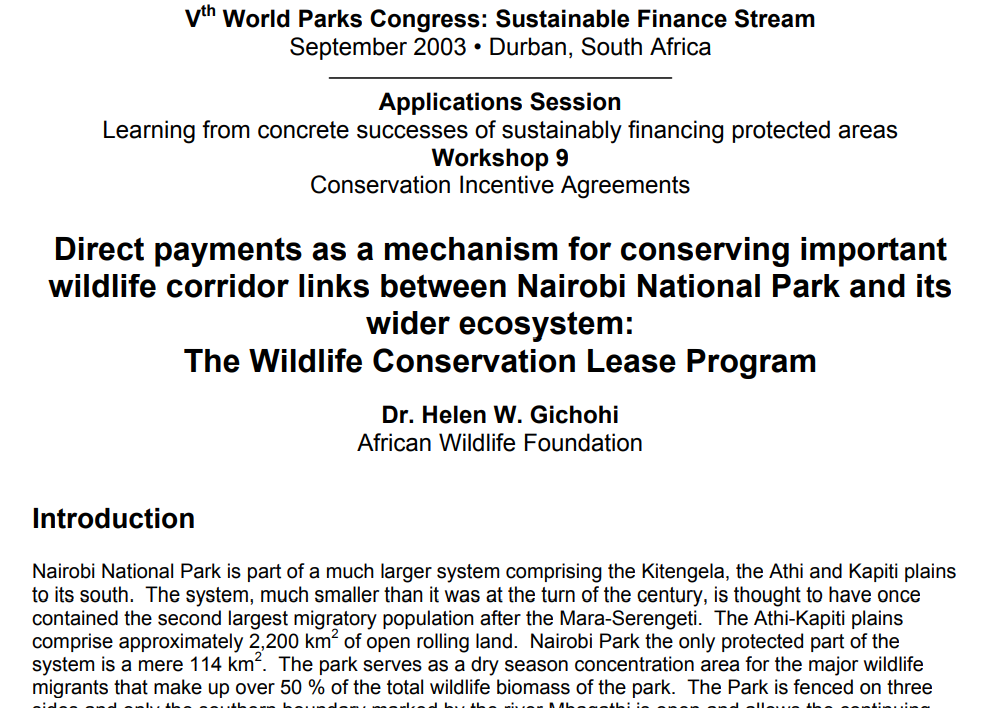
The Kitengela/Nairobi NP Wildlife Conservation Lease Program has been documented for years in conservation literature as an incentive mechanism designed to maintain open rangeland south of the park.
Separate research on compensation mechanisms around the corridor suggests there is meaningful willingness-to-pay among urban residents that could, in theory, finance compensation at scale (estimated aggregate support in the ~$1.2M/year range for 5 years in one analysis).
The key insight: the idea isn’t “charity.” It’s a rational attempt to correct a distribution problem: those who keep land open should be paid because they are producing a public ecological good.
2) Is KWS buying subdivided land realistic? Usually no—except at pinch points and only with partners
Why outright purchase is a hard long-run strategy
Land purchase faces three constraints that make it structurally difficult as a primary solution:
- Capital intensity: once subdivision accelerates, prices rise, parcels fragment, and transactions multiply. Buying enough land to preserve permeability becomes extremely expensive relative to conservation budgets.
- Holdout and speculation dynamics: the moment conservation buyers are credible, strategic sellers can demand premiums—especially for parcels that are obviously “critical.”
- Maintenance and governance: owning land is not the same as ensuring it stays ecologically functional (fencing decisions nearby can still block movement; enforcement costs remain).
What purchase can do is secure critical corridors and chokepoints—small areas where losing a few parcels would effectively shut the gate. That’s where purchase is most defensible, and it is consistent with the corridor logic embedded in national planning.
My view: If land purchase is used at all, it’s most rational as a surgical tool, not a scalable system—implemented with co-finance (donors, trusts, conservation finance) rather than KWS alone.
3) Leases are more realistic than purchase—but only if they scale faster than fencing
The corridor threat is real and measurable
Multiple sources (academic and policy-facing) describe ongoing fencing/subdivision pressure around NNP and the risk of blocking the southern migratory interface.
And this is not just about “nice-to-have migration.” There is evidence of severe historical declines in migratory herbivore populations associated with habitat change and loss of dispersal access in the greater ecosystem (e.g., wildebeest collapse narratives in the Athi-Kaputei / Nairobi ecosystem literature).
The lease model’s Achilles heel: it competes with a one-time land sale
A lease payment must compete against:
- the immediate cash and certainty of selling land,
- the perceived security of fencing for property rights,
- and the rising “option value” of holding land as Nairobi expands.
This is why some newer conservation-finance discussions increasingly emphasize direct payments to landowners and monitoring approaches as a way to keep land open now, even if payments begin small. A recent example described a pilot paying landowners for keeping land intact, reflecting the same economic logic: “pay the people who can close the corridor tomorrow.”
Bottom line: leases can be realistic, but only if they become (a) financially competitive enough, and (b) predictable enough, that landowners treat them as a stable income stream rather than a temporary project.
4) The uncomfortable question: is “eventual closure” the default trajectory?
If you look at corridor systems globally, the default outcome under rapid urban expansion is progressive narrowing, then functional collapse, unless there is a strong countervailing institution: zoning, easements, enforced land-use plans, or sustained payments.
KWS’s own planning acknowledges that the park’s future is entangled with its dispersal area.
Independent academic work on NNP governance similarly frames urban development pressure as a central threat requiring management strategies.
My prediction (explicitly probabilistic)
Assuming continued subdivision and fencing trends without a step-change in conservation finance and land-use governance:
- High probability (60–80%) the southern interface becomes significantly more constricted over the next 10–20 years (more fences, more settlement density, less permeability).
- Moderate probability (40–60%) of functional corridor closure for bulk grazers (especially migratory wildebeest-style movements) in the same horizon, even if some movement persists for smaller or more adaptable species.
This is not “doom as certainty.” It’s a statement about default economics: when land values rise and tenure fragments, open rangeland is a wasting asset unless someone pays to keep it open.
What could bend the curve
A credible “save the corridor” pathway almost certainly requires a portfolio, not a single intervention:
- Scaled leases / PES with multi-year certainty (so landowners can plan around it).
- Targeted purchases/easements at chokepoints (one-time capital where it buys permanent permeability).
- Land-use planning and enforcement (zoning, fencing rules, corridor recognition in county planning).
- Conflict mitigation so living with wildlife is not a net loss (predator-proof bomas, compensation mechanisms, community scouts). (The lease-program literature often bundles these supporting measures as necessary complements.)
5) If the southern corridor closes: what it means conservation-wise (beyond “fewer animals”)
Corridor closure is not just about seasonal movement. It changes the ecology of the entire park:
A) Herbivore dynamics: compression, lower resilience, and simplified communities
When dispersal space disappears, herbivores become more “park-bound.” That increases:
- resource competition and grazing pressure inside the park,
- vulnerability to drought variability,
- and the risk of long-term population decline (historically highlighted in the ecosystem literature around migratory species).
B) Predator dynamics: fewer wild prey → more livestock conflict
When prey availability outside the park collapses and movement is restricted, predation pressure can shift toward livestock at the boundary—raising conflict and retaliation risk. This dynamic is frequently described by corridor-focused reporting and research narratives around the southern interface.
C) Genetic and demographic isolation
NNP is already fenced on multiple sides; losing functional southern connectivity increases the risk of isolation effects (reduced gene flow for some species and less demographic “insurance” from broader landscapes). Even where fencing is not total, narrowing corridors can have similar effects in practice.
D) Management becomes more expensive, not cheaper
A more closed system tends to require:
- more active population management,
- more conflict response capacity,
- and more boundary security investment.
So the fiscal burden rises even as the ecological “return” declines.
Conclusion
Nairobi National Park is entering a phase where conservation is less about “protecting a park” and more about purchasing space in a real estate market. Leases like the Kitengela model are not a feel-good add-on—they are the only economically scalable tool that directly targets the mechanism of collapse: fencing and subdivision.
But leases only work if they are big enough, reliable enough, and long enough to outcompete land conversion. Without that scale, the southern corridor doesn’t need to be “officially closed” to fail—it will simply become too narrow and too fragmented for the ecosystem functions that once made Nairobi’s wildlife system resilient.
Related: