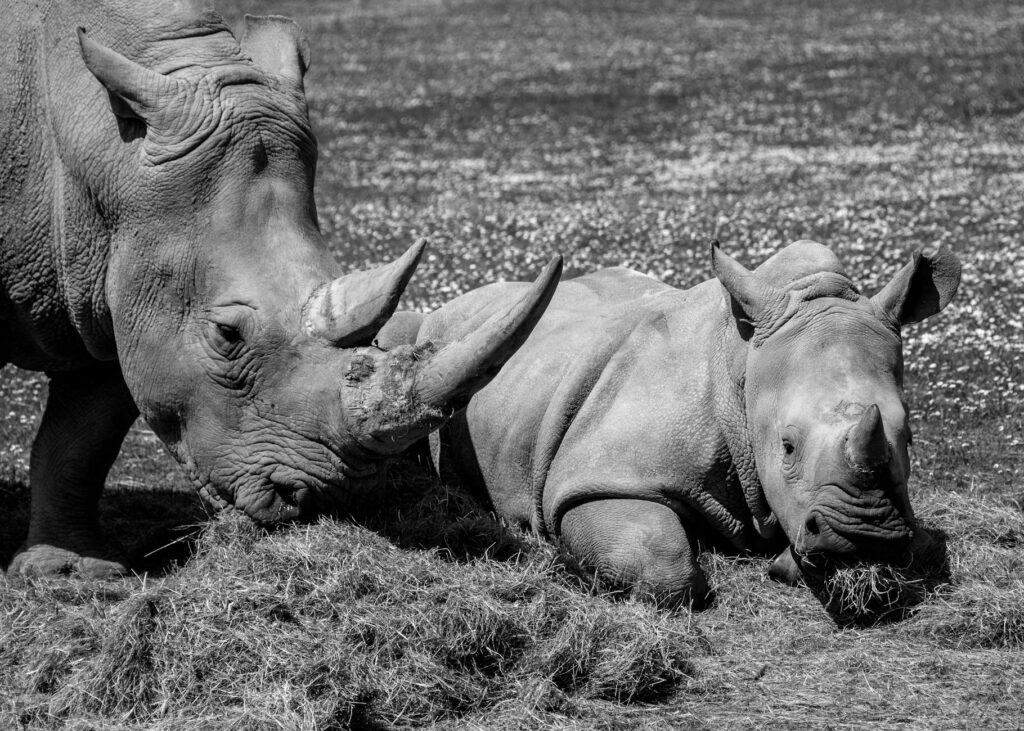
The black rhinoceros (Diceros bicornis) is one of the most iconic and conservation-significant species found in Nairobi National Park. As a critically endangered species globally, black rhinos in Nairobi National Park play a dual role: they are a flagship species for visitors and a core population for Kenya’s national rhino recovery strategy.
Nairobi National Park is internationally recognised as one of Africa’s most successful urban conservation landscapes—but its global reputation rests heavily on one powerful symbol: the Kifaru Ark. More than a monument, the Kifaru Ark represents Nairobi National Park’s role as a last lifeline for rhinos at a time when extinction seemed inevitable.
Today, the park protects one of the highest-density rhino populations in Africa, a dramatic recovery from the catastrophic poaching crisis of the 1970s and 1980s.
The Rhino Crisis: Why the Kifaru Ark Was Needed
By the late 1970s and 1980s, rhinos across Kenya were being wiped out at an unprecedented rate due to intense poaching driven by illegal horn trade.
At the national level:
- Kenya’s black rhino population collapsed from approximately 20,000 to just 384 individuals
- White rhinos declined to around 50 individuals nationwide
Inside Nairobi National Park, the situation was even more dire:
- Fewer than 10 rhinos remained by the late 1980s
This period marked the brink of ecological collapse. Without urgent intervention, Nairobi National Park—and Kenya as a whole—risked losing its rhinos entirely.
Kifaru is Swahili word for rhino.
Why Nairobi NP is referred to as Ark for Rhinos
Nairobi National Park is called the Ark because it served as a last refuge for rhinos when extinction was imminent, much like Noah’s Ark in the biblical story saved species during a global catastrophe.
During the 1970s and 1980s, Kenya’s rhino populations collapsed under intense poaching pressure: black rhinos fell from about 20,000 to fewer than 400 nationwide, white rhinos declined to around 50 individuals, and fewer than ten rhinos survived within Nairobi National Park. With most landscapes no longer safe, the park was deliberately designated as a high-security sanctuary, where rhinos could be intensively protected, closely monitored, and allowed to recover.
In this sense, Nairobi National Park functioned as a Kifaru Ark—carrying the last surviving rhinos through a conservation crisis and enabling population recovery. From this protected refuge, rhino numbers rebounded to around 175 individuals today, making the park one of Africa’s most successful rhino strongholds and a source population for restocking other protected areas.
The Kifaru Ark: A Sanctuary Against Extinction
In response, the Kenya Wildlife Service (KWS) designated Nairobi National Park as a high-security rhino sanctuary, later symbolised by the Kifaru Ark—an emblem representing a refuge carrying the last remaining rhinos through a storm of extinction risk.
The Ark concept reflected several critical strategies:
- Intensive 24-hour armed protection
- Fenced sanctuary management within the wider park
- Strict access control and monitoring
- Genetic and demographic population planning
- Long-term commitment to rhino breeding and recovery
The Kifaru Ark thus came to signify hope, resilience, and survival, positioning Nairobi National Park as a national conservation stronghold.
Recovery and Current Rhino Population (2025)
The results of this conservation intervention have been extraordinary.
According to Erastus Kanga, Director General of the Kenya Wildlife Service:
“We started with a population of less than 10… right now we are enjoying 49 white rhinos and 126 black rhinos. The rhino population in this park is about 175.” See the story on the Star Newspaper here.
Current Rhino Population in Nairobi National Park
Nairobi National Park currently supports an estimated 126 black rhinos alongside 49 white rhinos, bringing the park’s total rhino population to approximately 175 individuals. This represents a more than 17-fold increase from the park’s lowest point during the late 1980s, when fewer than ten rhinos remained.
As a result of this sustained recovery, Nairobi National Park now holds one of the highest rhino densities anywhere in Africa and functions as a globally significant breeding stronghold for the critically endangered black rhino, contributing directly to Kenya’s national and regional rhino conservation efforts.
Black Rhinos vs White Rhinos in Nairobi National Park
Black Rhinos
- Browsers that feed on shrubs and woody vegetation
- More solitary and elusive
- Classified as Critically Endangered
- Primary conservation priority of the Kifaru Ark
White Rhinos
- Grazers that prefer open grasslands
- More social and often seen in small groups
- Classified as Near Threatened
- Important for ecological balance and genetic diversity
Both species coexist successfully within the park’s mosaic of grassland, bushland, and riverine habitats.
Black Rhino vs White Rhino in Nairobi National Park- Comparison Table
| Aspect | Black Rhino | White Rhino |
|---|---|---|
| Scientific name | Diceros bicornis | Ceratotherium simum |
| Conservation status (IUCN) | Critically Endangered | Near Threatened |
| Population in Nairobi NP (2025) | ~126 individuals | ~49 individuals |
| Primary conservation role in the park | Core focus of the Kifaru Ark; globally important breeding population | Supplementary population supporting national recovery |
| Feeding type | Browser – feeds on shrubs, woody plants, and thorny vegetation | Grazer – feeds mainly on short grasses |
| Preferred habitat in Nairobi NP | Dense bushland, riverine thickets, scrub zones | Open grasslands and savannah plains |
| Body shape & size | Smaller, more compact body; pointed upper lip | Larger, heavier body; wide, square upper lip |
| Lip shape (key ID feature) | Hooked, prehensile lip adapted for browsing | Wide, flat lip adapted for grazing |
| Temperament | More solitary, shy, and elusive | More social, often seen in small groups |
| Activity pattern | Mostly crepuscular; prefers cover | Active throughout the day in open areas |
| Visibility on game drives | Seen regularly but often at a distance or in cover | Easier to spot due to open-habitat use |
| Poaching vulnerability (historical) | Extremely high; primary target during 1970s–80s crisis | High but less targeted historically |
| Breeding significance | Globally significant source population | Important but less critical genetically |
| Role in restocking other parks | Major source for translocations in Kenya | Occasional translocation source |
| Symbolic importance at Nairobi NP | Flagship species of the Kifaru Ark | Supporting species in sanctuary success |
| Horn characteristics | Two horns; front horn usually longer and narrower | Two horns; front horn broader and more rounded |
Helpful Notes:
While both species are vital to Nairobi National Park’s ecosystem, black rhinos are the conservation priority, representing one of Africa’s most important secure populations. The park’s ability to support both browsing and grazing rhino species within a compact, intensively protected landscape underscores why Nairobi National Park is considered a global model for high-security rhino conservation.
🦏 How to Tell Black and White Rhinos Apart in Nairobi National Park
You don’t need to be a wildlife expert—these simple cues make it easy to identify which rhino you’re seeing:
👄 Look at the Mouth
- Black rhino: Pointed, hooked upper lip (like a small beak) used for plucking leaves and twigs
- White rhino: Wide, flat mouth for grazing grass close to the ground
🌿 Watch What It’s Eating
- Black rhino: Browsing on bushes, shrubs, or thorny vegetation
- White rhino: Grazing in open grasslands with head down
🏞️ Notice the Habitat
- Black rhino: Often near thickets, bushy areas, or riverine vegetation
- White rhino: Usually in open plains and grassy areas
🧍 Body Shape & Size
- Black rhino: Smaller, more compact, with a slightly higher head carriage
- White rhino: Larger, heavier, with a broad chest and head held low
👀 Behaviour
- Black rhino: Solitary and more elusive
- White rhino: More relaxed, sometimes seen in small groups
Quick tip:
If the rhino is in the bushes using a pointed lip, it’s likely a black rhino.
If it’s grazing in open grass with a wide mouth, it’s likely a white rhino.
Where the Rhino Sanctuary Is Located
The Black Rhino Sanctuary lies within Nairobi National Park itself, not inside the Nairobi Animal Orphanage.
Key clarifications:
- The sanctuary is part of the park’s core conservation zone
- It is not a zoo or captive facility
- Rhinos roam within protected but natural landscapes
- Visitors encounter rhinos during normal game drives, not via enclosures
The Animal Orphanage, by contrast, serves injured or rehabilitating animals and is a separate attraction.
Seeing Rhinos on a Game Drive
Rhinos are among the most reliable Big Five sightings in Nairobi National Park. You have a better chance seeing rhinos at Nairobi Park than in Masai Mara NR or in Amboseli NP.
What increases your chances:
- Early morning or late afternoon drives
- Grassland zones near sanctuary-managed areas
- Full-day game drives offering broader coverage
Both half-day and full-day safaris regularly encounter black and white rhinos, often within a short distance of Nairobi’s skyline—one of the park’s most iconic contrasts.
Why Nairobi National Park Remains Critical for Rhino Survival
Nairobi National Park is not just a refuge—it is a source population supporting rhino conservation nationally.
The park:
- Supplies rhinos for carefully managed translocations
- Maintains genetic diversity through active population management
- Demonstrates how high-security conservation can succeed near major cities
- Acts as a training and policy model for other sanctuaries in Kenya
Without the park and its surrounding dispersal systems, Kenya’s rhino recovery would have been impossible.
Ongoing Challenges and Future Safeguards
Despite success, risks remain:
- Urban expansion around the park
- Pressure on wildlife corridors
- Continued international demand for rhino horn
To address these, KWS continues to invest in:
- Technology-assisted anti-poaching
- Community engagement and intelligence networks
- Corridor protection and land-use planning
- Regional conservation partnerships
The Kifaru Ark Legacy
Today, the Kifaru Ark stands as a conservation milestone:
- From fewer than 10 rhinos to about 175
- From near extinction to global conservation leadership
- From crisis to one of Africa’s most successful rhino recovery stories
Nairobi National Park has earned its reputation not only as a city park—but as a living ark that carried rhinos through humanity’s most dangerous chapter for the species.
This guide explains where black rhinos live in the park, how likely you are to see them, how they are protected, and why Nairobi National Park is uniquely important for their survival.
What Makes Black Rhinos Different?
Black rhinos are often misunderstood. Despite the name, they are not black in colour—the term distinguishes them from white rhinos.
Key characteristics include:
- A hooked, prehensile upper lip used for browsing shrubs and trees
- A compact, muscular build suited to dense bush
- Solitary and territorial behaviour, especially among adults
- Strong reliance on thick cover and riverine vegetation
Unlike white rhinos, which are grazers, black rhinos are browsers, feeding on acacias, commiphora, and other woody plants common in Nairobi National Park.
Are Black Rhinos Found Throughout Nairobi National Park?
Black rhinos are fully wild and free-ranging within the park, but they are not evenly distributed. They tend to concentrate in:
- Dense bushland and thickets
- Riverine zones such as the Mbagathi River system
- Areas with lower tourist traffic and good cover
They are not confined to the Animal Orphanage area and are not kept in enclosures. When visitors refer to a “black rhino sanctuary,” they are describing a managed conservation zone within the park, not a fenced attraction.
Will I See Black Rhinos on a Game Drive?
Yes—Nairobi National Park is one of the most reliable places in Kenya to see black rhinos, especially compared to much larger parks.
Sightings depend on:
- Time of day (early morning and late afternoon are best)
- Seasonal vegetation density
- Guide experience and tracking knowledge
Both half-day and full-day game drives regularly record black rhino sightings. A full-day drive increases overall wildlife diversity, but a half-day drive is often sufficient specifically for rhinos.
Are Black Rhinos Dangerous?
Black rhinos have a reputation for aggression, but this is context-dependent.
Important points for visitors:
- Black rhinos are extremely shy and defensive, not predatory
- They pose no risk to visitors in vehicles
- All sightings are managed at safe distances by trained guides
Incidents involving people are exceptionally rare and typically linked to surprise encounters on foot—something not permitted for visitors.
How Are Black Rhinos Protected in Nairobi National Park?
Kenya Wildlife Service (KWS) maintains a specialised Rhino Monitoring and Protection Unit at Nairobi National Park, dedicated exclusively to safeguarding black and white rhinos. Rangers conduct daily on-foot patrols, supported by evening and night surveillance, to locate individual rhinos, assess their condition, and record movements and breeding activity. Living in mobile field camps within the park, the unit provides round-the-clock security across the 117 km² landscape.
Despite reduced poaching pressure, rhino protection remains a high-risk priority due to the park’s urban setting. The unit’s continuous presence, intelligence-led patrols, and detailed monitoring have been central to Nairobi National Park’s recovery from fewer than 10 rhinos in the late 1980s to about 175 rhinos today, making it one of Africa’s most successful rhino sanctuaries.

Protection measures include:
- 24-hour armed ranger patrols
- Continuous individual rhino identification and monitoring
- Veterinary surveillance and rapid response units
- Intelligence-led anti-poaching operations
As a result, poaching rates in Nairobi National Park are extremely low, especially compared to open rangeland systems.
Why Nairobi National Park Is Critical for Black Rhino Conservation
Despite its relatively small size, Nairobi National Park is strategically vital because:
- It functions as a secure breeding stronghold
- It supports genetically important individuals
- It serves as a source population for translocations to other Kenyan sanctuaries
When rhino density approaches ecological limits, selected individuals are relocated to other protected areas, strengthening rhino populations nationally.
Do Black Rhinos Migrate Out of the Park?
No. Unlike wildebeest or zebra, black rhinos are non-migratory. They maintain small, well-defined home ranges and rarely move into surrounding dispersal areas such as Kitengela.
This makes habitat security inside the park especially important for their long-term survival.
Black Rhinos vs White Rhinos in Nairobi National Park
Both species occur in Nairobi National Park, and visitors often see both on the same drive.
| Feature | Black Rhino | White Rhino |
|---|---|---|
| Feeding style | Browser | Grazer |
| Lip shape | Hooked | Wide, square |
| Social behaviour | Solitary | More social |
| Habitat | Dense bush | Open grassland |
Understanding these differences helps visitors appreciate why both species are needed to maintain ecological balance.
Photography and Viewing Ethics
Visitors may photograph black rhinos freely from vehicles, but strict rules apply:
- No off-road driving
- No flash photography
- No attempts to attract attention
- Maintain appropriate distance at all times
These rules protect both rhino welfare and visitor safety.
When Is the Best Time to See Black Rhinos?
Black rhinos can be seen year-round, but optimal conditions include:
- Dry seasons (January–March, July–October) when vegetation is thinner
- Early morning or late afternoon game drives
Because they are resident, there is no seasonal absence.
Black Rhinos and the Bigger Conservation Picture
The long-term survival of black rhinos in Nairobi National Park is linked to:
- Maintaining habitat quality inside the park
- Reducing ecological isolation through land-use planning around the park
- Sustained funding for high-intensity protection
Black rhinos are not just another species here—they are a measure of whether Nairobi National Park can continue functioning as a viable conservation landscape in an urbanising world.
In Summary
Seeing a black rhino in Nairobi National Park is not just a wildlife sighting—it is direct evidence that intensive conservation works. Few capital cities on Earth can claim a thriving population of critically endangered megafauna within sight of a skyline.
Will I see the Black Rhino Sanctuary on a Nairobi National Park game drive?
Yes. Black rhinos are encountered during standard game drives inside Nairobi National Park.
However, it’s important to understand that:
- The Black Rhino Sanctuary is not a fenced “display area” or a single marked location you drive into
- It refers to secure rhino ranges within the park, managed and patrolled by Kenya Wildlife Service
- Rhinos move freely within suitable habitat inside the park
During a game drive, your driver-guide will look for rhinos in known rhino-use areas, typically bushy zones and riverine sections.
Is the Black Rhino Sanctuary located at the Animal Orphanage?
No. The Black Rhino Sanctuary is completely separate from the Nairobi Animal Orphanage.
Key distinction:
- Nairobi Animal Orphanage
- A rehabilitation and education facility
- Houses injured, rescued, or confiscated animals
- Functions more like a wildlife rescue center
- Black Rhino Sanctuary
- A wild, in-situ conservation area inside the national park
- No cages or enclosures for visitors
- Rhinos live and breed naturally
You will not see black rhinos inside the orphanage.
How are black rhinos seen during a game drive?
Black rhinos in Nairobi National Park:
- Are wild and free-ranging
- Prefer dense bush and riverine vegetation
- Are usually spotted:
- Early morning
- Late afternoon
- Away from busy open plains
Sightings are common compared to many other parks, but still depend on luck, timing, and guide experience.
What to expect as a visitor
- You do not drive into a fenced “rhino sanctuary” zone
- You may encounter black rhinos naturally while exploring the park
- Viewing is always:
- From the vehicle
- At a safe distance
- Non-intrusive
This is what makes Nairobi National Park special — black rhinos are part of the real, functioning ecosystem, not a separate attraction.
In summary
- ✅ Yes, you can see black rhinos on a Nairobi National Park game drive
- ❌ No, the sanctuary is not at the animal orphanage
- 🦏 Rhinos live freely within protected areas of the park, not in visitor enclosures
Black Rhino Sanctuary Nairobi – Additional FAQs
Can I specifically request a “Black Rhino Sanctuary tour” in Nairobi National Park?
No. There is no separate or bookable sanctuary tour. Black rhinos are seen as part of a standard Nairobi National Park game drive, moving freely within protected ranges inside the park.
Are black rhinos in Nairobi National Park tracked or monitored?
Yes. Black rhinos are individually identified and closely monitored by Kenya Wildlife Service using visual IDs, patrol observations, and periodic veterinary checks to manage population health and security.
Do black rhinos cross into Kitengela or leave the park?
Black rhinos mostly remain inside the park, unlike grazers such as wildebeest or zebra. They are territorial browsers and rarely move far beyond secure park boundaries, especially in an urban-adjacent landscape.
How do black rhinos coexist with lions and other predators?
Adult black rhinos have no natural predators. Lions may pose a risk to calves, but dense habitat use and maternal behaviour significantly reduce this threat. Rhino mortality in Nairobi National Park is not predator-driven.
Are black rhinos active during the day or night?
Black rhinos are most active early morning and late afternoon, resting in thick cover during the hottest parts of the day. Night activity increases, but this is outside visitor viewing hours.
Can children safely see black rhinos on a game drive?
Yes. Viewing black rhinos from a vehicle is completely safe for children, provided park rules are followed. Nairobi National Park is one of the best educational settings for seeing rhinos responsibly.
How close do vehicles get to black rhinos?
Vehicles must maintain a safe, non-intrusive distance. Guides position vehicles based on rhino behaviour, wind direction, and visibility. Approaching too closely is prohibited.
Are black rhinos ever relocated from Nairobi National Park?
Yes. When population density approaches ecological limits, selected individuals are translocated to other rhino sanctuaries in Kenya to support national conservation goals and genetic diversity.
How can visitors tell black rhinos apart from white rhinos?
Key differences:
- Black rhinos have a hooked upper lip (for browsing)
- They are smaller and more compact
- They prefer bushier habitats
- They are usually solitary
Both species are present in Nairobi National Park.
Is photography of black rhinos allowed?
Yes. Photography is allowed from vehicles. Flash photography, off-road driving, or attempts to attract attention are strictly prohibited.
Does seeing black rhinos cost extra?
No. There is no additional fee to see black rhinos beyond the standard Nairobi National Park entry ticket and game drive cost.
Are black rhinos visible on half-day game drives?
Yes. Black rhinos are commonly seen on half-day drives, especially morning drives. A full-day drive increases overall wildlife diversity but is not required specifically for rhinos.
Why is Nairobi National Park considered important for black rhinos compared to larger parks?
Because of:
- Exceptionally high protection levels
- Intensive monitoring
- Low poaching risk
- Strong institutional presence
Nairobi National Park functions as a high-security breeding stronghold, not just a viewing area.
What is the biggest current threat to black rhinos in Nairobi National Park?
Not poaching. The biggest long-term threat is habitat pressure and ecological isolation if surrounding wildlife corridors and dispersal areas continue to shrink.
Can black rhinos be seen year-round?
Yes. Black rhinos are resident and non-migratory, making Nairobi National Park a year-round destination for rhino sightings.
Is the Black Rhino Sanctuary open for walking or cycling?
No. The sanctuary is not accessible on foot or bicycle. All rhino viewing is done from vehicles during authorised game drives only.
Frequently Asked Questions: Black Rhinos at Nairobi National Park
1. How many black rhinos are currently in Nairobi National Park?
Nairobi National Park supports one of Kenya’s most important rhino populations, with approximately 175 rhinos in total—comprising about 126 black rhinos and 49 white rhinos. This makes the park a critical stronghold for black rhino conservation, with numbers actively managed to balance breeding success, habitat capacity, and long-term genetic health.
2. Are black rhinos guaranteed to be seen on a game drive?
No wildlife sighting is ever guaranteed, but Nairobi National Park offers among the highest probabilities of black rhino sightings in Kenya, especially with an experienced driver-guide and an early-morning or late-afternoon drive.
3. Can I see black rhinos on a short layover or half-day visit?
Yes. Black rhinos are resident and non-migratory, making them realistic to see even on a 4–5 hour half-day game drive, particularly in the central and southern sectors of the park.
4. Do black rhinos stay far from tourist roads?
Not necessarily. While they prefer dense cover, black rhinos in Nairobi National Park are accustomed to vehicles and are often seen crossing or browsing near established game-drive circuits.
5. Are black rhinos ever active during midday?
They are less active during midday heat but may still be seen resting, browsing in shade, or moving between cover, especially during cooler or overcast days.
6. Can children safely see black rhinos on a game drive?
Yes. All rhino viewing is done from within a vehicle, and black rhinos pose no risk to visitors under standard park rules. Nairobi National Park is considered family-friendly for wildlife viewing.
7. Are black rhinos tagged or collared in the park?
Some individuals may carry monitoring devices for conservation and research purposes, but many are identified through horn shape, scars, and behavioral patterns rather than visible collars.
8. Is Nairobi National Park important for black rhino breeding?
Yes. The park is recognized as a key breeding and source population, with surplus individuals periodically translocated to strengthen other rhino sanctuaries across Kenya.
9. Can black rhinos be seen near the Nairobi skyline?
Occasionally, yes. One of Nairobi National Park’s unique features is the possibility of seeing black rhinos against the city skyline, particularly in open plains near the southern and central park areas.
10. Are black rhinos affected by traffic or aircraft noise from the city?
Long-term monitoring shows that black rhinos have adapted well to background urban noise within the park, provided habitat quality and security are maintained.
11. Do black rhinos use the same areas as white rhinos?
Sometimes, but they generally partition habitat by feeding style—black rhinos favor bushier areas, while white rhinos concentrate in open grasslands, reducing direct competition.
12. Are black rhinos visible year-round?
Yes. Because they are resident and do not migrate, black rhinos can be seen throughout the year, unlike seasonal species.
13. Is Nairobi National Park better for black rhino sightings than larger parks?
In many cases, yes. Despite its smaller size, the combination of high rhino density, strong protection, and accessible terrain often makes Nairobi National Park more reliable for sightings than much larger reserves.
14. Can I photograph black rhinos with a standard camera or phone?
Yes. Sightings often occur at reasonable viewing distances, making photography possible even without professional telephoto equipment—especially in open or lightly wooded areas.
15. Why are black rhinos easier to see in Nairobi National Park than expected?
Because the park functions as a secure, intensively managed refuge, black rhinos experience lower disturbance and predation risk, allowing them to occupy predictable home ranges that guides know well.
Final Perspective
The Black Rhino Sanctuary in Nairobi National Park is more than a protected area—it is a living conservation success story. Against the backdrop of a growing city, it shows that long-term commitment, science-based management, and effective protection can secure the future of one of Africa’s most endangered species.