
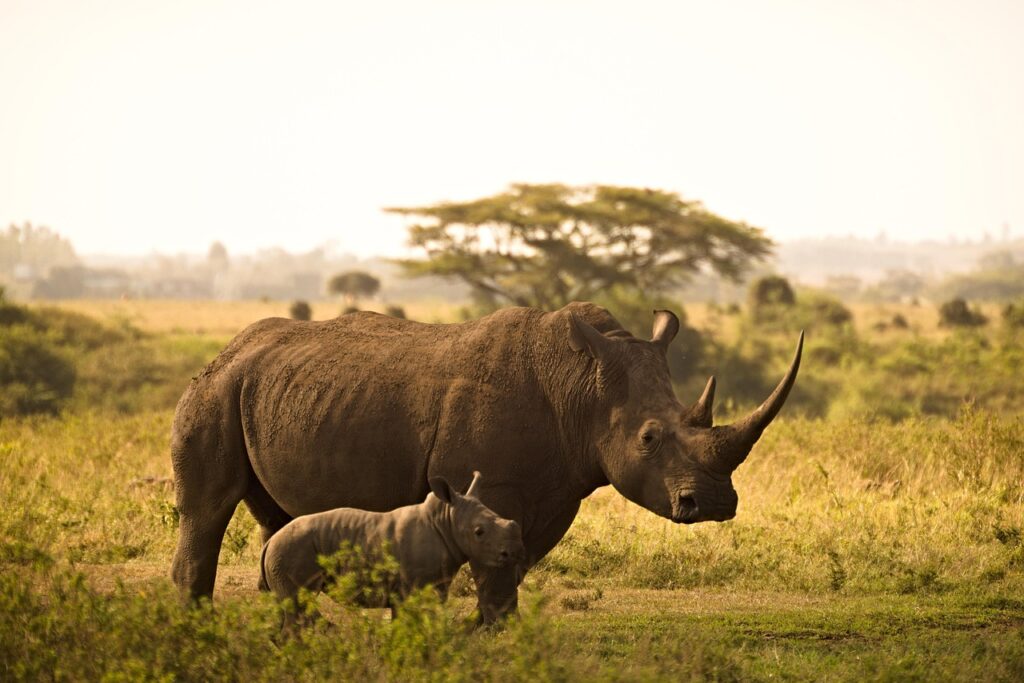
From Near-Extinction to a National Conservation Stronghold
Nairobi National Park is not simply a place where visitors can see rhinos against a city skyline. It is a strategically managed rhino stronghold—one of Kenya’s most successful sanctuaries for both black and white rhinoceros—operating within an unusually complex urban-edge conservation landscape. Here, security, population biology, genetics, habitat management, and human–wildlife coexistence must all be managed at exceptionally high intensity.
Today, Nairobi National Park stands as a rare global case where conservation success has created a new challenge: overcapacity, requiring active population redistribution rather than emergency protection.
1. Why Nairobi National Park Matters for Rhino Conservation
1.1 A high-security rhino sanctuary in an urban ecosystem
- Nairobi NP is formally recognized by Kenya Wildlife Service (KWS) as one of Kenya’s most successful rhino sanctuaries.
- Unlike remote rhino landscapes, the park lies beside major highways, rail lines, and dense urban settlement, making:
- poaching risk,
- fence integrity,
- intelligence-led patrols, and
- rapid-response capacity
central to daily management.
- This proximity has forced Nairobi NP to pioneer high-intensity protection models now applied elsewhere in Kenya.
1.2 A national “source population” role
- Nairobi NP functions as a donor population within Kenya’s wider rhino recovery strategy.
- Well-protected sanctuaries like Nairobi NP serve as:
- breeding nuclei,
- genetic reservoirs, and
- sources for carefully planned translocations to new or expanded rhino ranges.
- This role places Nairobi NP at the center of Kenya’s long-term rhino security planning.
2. Rhino Numbers: From Crisis to Overcapacity
2.1 Collapse and emergency protection (1980s)
- In the late 1980s:
- Nairobi NP held fewer than 10 rhinos.
- Kenya’s black rhino population had crashed from ~20,000 to ~384 individuals.
- White rhinos numbered only ~50 nationally.
- This crisis triggered decisive government action, including the formal designation of rhinos as a fully protected species and the creation of intensive sanctuary systems as reported by the Star Newspaper.
2.2 Recovery and current population (2025)
According to Erastus Kanga, Director General of KWS:
- Black rhinos: 126
- White rhinos: 49
- Total rhinos in Nairobi NP: ~175 individuals
This represents one of the highest rhino densities in Africa and a >17-fold increase from the park’s lowest point.
“We started with a population of less than 10… right now we are enjoying 49 white rhinos and 126 black rhinos. The rhino population in this park is about 175.” — Erastus Kanga
3. Carrying Capacity: When Conservation Succeeds Too Well
3.1 Ecological limits
- Estimated carrying capacity: ~90–100 rhinos
- Current population: ~175 rhinos
- Excess above capacity: ~70–80 individuals
Carrying capacity refers to the maximum number of animals an ecosystem can support without habitat degradation, suppressed reproduction, or elevated conflict.
3.2 Consequences of overcrowding
- Territorial fighting, especially among male black rhinos (often fatal)
- Forced dispersal beyond park boundaries into community areas
- Suppressed birth rates as rhinos respond physiologically to crowding
- Increased management risk, including fence breakage and human injury
A documented case involved a male black rhino exiting the park three times in one week, prompting its relocation for safety and welfare reasons.
“Now we are suffering because of our success.” — Erastus Kanga
4. Types of Rhino Species in Nairobi NP
4.1 Black rhinoceros (Diceros bicornis)
- Global status: Critically endangered
- Ecological role: Browser with a hooked lip, shaping shrubs and woodland structure—often described as a “vegetation architect.”
- Behavior: Solitary, cryptic, prefers dense cover; more aggressive and harder to monitor.
- Management implication: Requires larger territories and careful density control.
4.2 White rhinoceros (Ceratotherium simum)
- Status: Conservation success in parts of Africa, but still a high-value poaching target.
- Ecological role: Grazer that maintains short-grass lawns, benefiting other herbivores.
- Behavior: More social and visible in open habitat.
- Management implication: Easier to monitor, but contributes heavily to grazing pressure.
4.3 Why black vs white matters
Maintaining both species:
- increases ecological completeness, but
- demands dual habitat management strategies, different patrol patterns, and more complex population planning.
🦏 Black Rhino vs White Rhino in Nairobi National Park
| Aspect | 🦏 Black Rhino (Diceros bicornis) | 🦏 White Rhino (Ceratotherium simum) |
|---|---|---|
| Conservation status (global) | Critically Endangered | Near Threatened (with stronghold populations) |
| Primary conservation priority in Kenya | Highest – flagship species for intensive protection | High – major recovery success but still vulnerable |
| Estimated population in Nairobi NP (2025) | ~126 individuals | ~49 individuals |
| Feeding strategy | Browser – feeds on shrubs, woody plants, and thickets | Grazer – feeds mainly on short grasses |
| Lip shape (key ID feature) | Hooked, prehensile upper lip | Wide, square mouth |
| Ecological role | Shapes bush and woodland structure (“vegetation architect”) | Maintains grazing lawns benefiting other herbivores |
| Social structure | Mostly solitary; highly territorial (especially males) | More social; often seen in small groups |
| Temperament | More aggressive and unpredictable | Generally calmer but still dangerous if provoked |
| Visibility to visitors | Less visible; prefers dense cover | More visible; often in open grassland |
| Typical habitat use in Nairobi NP | Thickets, bushy plains, mixed woodland | Open plains, short-grass areas near water |
| Monitoring complexity | High – cryptic behavior and solitary habits | Moderate – open habitat and group living |
| Role in current translocations | Frequently prioritized to reduce territorial conflict | Translocated mainly to manage grazing pressure |
📍 Where to See Rhinos in Nairobi National Park
🦏 Black Rhino – Best Areas & Conditions
- Typical zones:
- Central plains with bush cover
- Mixed shrub–grass mosaics
- Areas away from heavy tourist traffic
- Best time:
- Early morning (6:00–9:00 AM)
- Late afternoon (4:00–6:00 PM)
- Expert insight:
Black rhinos are often present but unseen. Look for:- fresh tracks crossing roads,
- broken shrubs,
- dung middens used for territorial marking.
Black rhino sightings in Nairobi NP are more frequent than in many large parks, but still require patience and a skilled guide.
🦏 White Rhino – Best Areas & Conditions
- Typical zones:
- Open grasslands
- Short-grass plains near water sources
- Broad visibility areas around the central and southern park
- Best time:
- Morning and late afternoon, especially during dry periods
- Expert insight:
White rhinos are often seen actively grazing in the open, making them:- easier to locate,
- excellent subjects for photography,
- a strong indicator of habitat carrying capacity issues when numbers rise.
🧠 Why Visitors Often See Both Species in Nairobi NP
Nairobi National Park is unusual because:
- It combines intensive protection,
- small spatial scale, and
- high rhino density
This makes it one of the best places in Kenya to compare black and white rhinos in a single safari, especially for educational or conservation-focused visitors.
⚠️ Important Conservation Context for Visitors
- Nairobi NP is currently over its rhino carrying capacity, meaning:
- sightings are relatively frequent,
- but management now focuses on translocation and conflict reduction, not population growth.
- Rhino visibility should never be confused with “abundance without limits”—continued protection is essential.
🧭 Quick Field Tips
- If you see short, cropped grass lawns → scan for white rhino.
- If impala suddenly scatter near bushes → scan edges for black rhino.
- Never block a rhino’s path or approach too closely—both species can charge with little warning.
5. Kenya’s Rhino Sanctuary Model—and Nairobi NP’s Advantage
5.1 National sanctuary strategy
Kenya’s rhino recovery has relied on:
- concentrated security,
- individual identification and monitoring,
- veterinary capacity,
- deliberate population management, including translocation.
There are now ~19 rhino sanctuaries nationwide.
5.2 Nairobi NP’s unique strengths
- Immediate access to:
- specialized KWS units,
- veterinary expertise,
- high-frequency patrol logistics.
- Nairobi NP has a dedicated rhino protection unit, reflecting the species’ exceptional security requirements.
6. Anti-Poaching and Security:
6.1 Dedicated rhino protection units
- Rhino protection in Nairobi NP is species-specific, not general wildlife patrol.
- Teams are trained around:
- rhino behavior,
- threat anticipation,
- rapid intervention.
Read on KWS’ Website details on Rhino Unit at Nairobi NP and recent enhanced methods to improve surveillance.
6.2 Surveillance and rapid response
Key pillars include:
- layered foot patrols,
- intelligence-led threat detection,
- rapid deployment near boundaries and corridors,
- investigative follow-up.
(Operational details remain deliberately undisclosed.)
7. Monitoring, Identification, and Veterinary Management
7.1 Individual rhino monitoring
Each rhino is effectively managed as an individual biological unit, tracked by:
- horn shape, scars, behavior,
- body condition and injuries,
- reproductive status and calf survival,
- changes in spatial use.
7.2 Veterinary response
Rhino conservation requires:
- immobilization capability,
- trauma treatment (snaring, fighting injuries),
- disease surveillance,
- post-translocation health monitoring.
Kenya operates under formal national technical protocols for rhino handling and movement.
8. Translocation: Managing Success, Not Failure
8.1 Why rhinos are moved from Nairobi NP
Translocations from Nairobi NP now occur to:
- relieve overcapacity,
- reduce lethal territorial conflict,
- support national range expansion,
- establish new secure populations.
8.2 Kenya Rhino Range Expansion Programme
Under the government-backed Kenya Rhino Range Expansion Programme, Kenya is:
- expanding secure rhino habitat,
- rebuilding under-utilized sanctuaries.
A flagship project is the expansion of Ngulia Rhino Sanctuary:
- from 92 km² to ~3,000 km² within Tsavo West National Park.
Ngulia currently holds ~140 rhinos against a capacity of ~60, illustrating that overcapacity is a national-scale issue, not unique to Nairobi NP.
9. Genetics, Connectivity, and the Small-Park Reality
- Small or fenced systems risk genetic bottlenecks without managed movement.
- Kenya applies:
- selective translocation,
- age/sex balancing,
- national meta-population planning.
- Nairobi NP’s role is integrated into a countrywide genetic strategy, not managed in isolation.
10. Habitat Management for Rhinos in Nairobi NP
10.1 Species-specific habitat needs
- Black rhino: browse availability, cover, water.
- White rhino: productive grazing lawns, open visibility, water.
10.2 Water and dry-season concentration
- Predictable water points:
- improve sighting probability,
- increase security pressure,
- intensify habitat wear.
10.3 Fire, grass, and invasive control
Management must balance:
- grass productivity,
- browse regeneration,
- controlled burning,
- invasive plant suppression.
11. Threats and Constraints
11.1 Poaching and illegal trade
- Rhino horn demand remains the primary long-term threat, despite population gains.
11.2 Infrastructure and urban expansion
- Roads, fencing, and development increase:
- fragmentation,
- incursion risk,
- edge effects.
11.3 Human–rhino interaction
- Less frequent than predator conflict, but potentially severe due to rhino strength and unpredictability.
12. Governance, Institutions, and Leadership
- Kenya Wildlife Service leads rhino management and protection.
- Scientific input is provided by the Wildlife Research and Training Institute.
- National political support has remained visible, including leadership by Rebecca Miano.
- Kenya now hosts:
- >90% of the eastern black rhino population, and
- the third-largest rhino population in Africa.
13.🦏 Viewing Rhinos at Nairobi National Park
Rhino sightings in Nairobi National Park are among the strongest in Kenya, but outcomes depend on time available, route choice, and starting location.
⏱️ Half-Day Safari (4–5 hours): Where to Focus
If you are on a half-day safari and your priority is seeing black and white rhinos, efficiency matters. Key areas to start and concentrate your game drive include:
- Central Plains / Rhino Core Zones – historically reliable rhino habitat with mixed bush and open grass
- Ivory Burning Site Plains – open visibility favors white rhino sightings
- Athi Basin edges – productive grazing and browse, especially early morning
- Leopard Cliff approach roads – transitional habitat where rhinos frequently cross tracks
Best timing:
- Early morning (6:00–9:00 AM) or
- Late afternoon (4:00–6:00 PM)
These cooler periods coincide with increased rhino movement and grazing.
Expert note: On a half-day drive, avoid long detours to wetlands or heavy predator zones if rhinos are your main goal—stay in open plains and bush–grass mosaics where tracking is most effective.
🕘 Full-Day Safari (8–12 hours): Expanding Your Chances
With a full-day tour, guides can adopt a more adaptive strategy:
- Start in central and southern plains during early hours
- Track rhinos as they shift between browse areas and water points
- Revisit productive zones later in the day as animals re-emerge from shade
- Combine rhino focus with broader wildlife viewing without sacrificing probability
Full-day safaris allow for multiple passes through high-density rhino areas, significantly increasing the likelihood of observing both black and white rhinos, as well as calves and territorial behavior.
🎯 Bottom Line
- Half-day safari: Focus tightly on central plains and open grassland corridors
- Full-day safari: Enables flexible tracking and repeated coverage of rhino zones
Nairobi National Park’s intensive sanctuary management means rhinos are often seen, but success still depends on starting in the right places and managing time intelligently—especially on shorter drives.
Responsible viewing
- Best times: early morning and late afternoon.
- Maintain distance; never block movement.
- Rhino sightings are high-probability but not guaranteed.
Why sightings are often strong
- Intensive protection + suitable habitat mosaics + long-term monitoring.