Nairobi National Park in one answer
Nairobi National Park still works as a real ecosystem because its 117 sq. km protected landscape contains open grassland, wooded grassland, shrubland, highland dry forest, rivers, wetlands, rhinos, lions, herbivores, crocodiles, hippos, and more than 500 bird species, while its partly open southern edge still links wildlife to the wider Athi-Kapiti landscape.
KWS describes Nairobi National Park as “The World’s only Wildlife Capital,” located about 8–10 km from Nairobi’s central business district, with 100 mammal species, 500 migratory and endemic bird species, black and white rhinos, lions, leopards, giraffes, buffalo, zebra, hippos, crocodiles, and a park size of 117 sq. km.
The stronger story is not “wild animals with skyscrapers behind them.” The stronger story is that a capital city has grown around a park that still has predator-prey relationships, grazing pressure, browsing niches, wetland life, bird movement, rhino conservation, and seasonal dispersal pressure. That is why the page should move beyond generic skyline safari copy and explain the park as a functioning urban-edge ecosystem.
Quick ecological summary
| Ecosystem feature | Why it matters |
|---|---|
| Open grassland | Supports zebra, wildebeest, buffalo, gazelles, white rhinos, ostriches, lions, cheetahs, and skyline viewing |
| Wooded grassland | Supports giraffes, black rhinos, impala, birds, shade use, and predator cover |
| Open shrubland | Supports rhinos, browsers, grazers, carnivores, and edge birds |
| Highland dry forest | Adds canopy habitat, shade, forest-edge species, and plant diversity |
| Rivers and wetlands | Support hippos, crocodiles, amphibians, waterbirds, dry-season water access, and animal tracks |
| Rhinos | Make the park a high-value sanctuary and conservation asset |
| Lions and carnivores | Prove that prey, cover, territory, and movement still function |
| Migratory grazers | Link the park to wider dispersal lands and seasonal movement |
| Southern boundary | Keeps the park from becoming a sealed urban wildlife island |
| Birdlife | Shows habitat diversity across grassland, wetland, woodland, and forest-edge zones |
The KWS Nairobi National Park Management Plan identifies seven conservation targets for the park: black rhino, migratory species, large carnivores, wooded and open grassland, open low shrubland, highland dry forest, and river systems and wetlands.
What makes Nairobi National Park a real ecosystem?
Nairobi National Park is a real ecosystem because wildlife still depends on habitat structure, water, prey movement, predator behavior, breeding space, seasonal dispersal, and conservation management, not only on enclosure or human feeding.
A real ecosystem has relationships. Grass feeds grazers. Shrubland feeds browsers. Grazers feed predators. Wetlands support water-dependent animals and birds. Forest edges provide shade, cover, nesting sites, and plant diversity. Corridors allow movement. Management protects species that cannot survive inside an urban landscape without active security.
Nairobi National Park has those relationships, even under pressure. KWS states that the park’s purpose is to protect critical habitats, especially highland dry forest, savannah, and wetlands, plus wildlife species of conservation concern such as rhinos and lions.
Why the skyline is not the main story
The Nairobi skyline shows proximity, but the ecosystem story comes from what still happens in the grass, water, forest edge, and southern dispersal landscape.
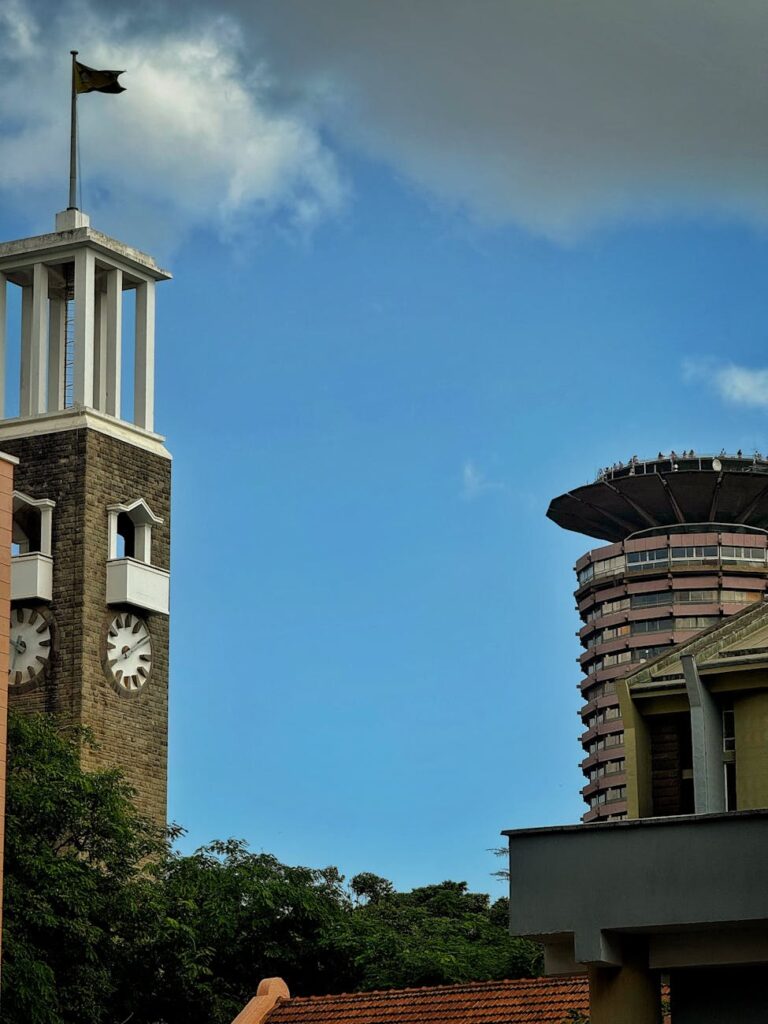
The skyline makes Nairobi National Park famous because few safari scenes place giraffes, rhinos, buffalo, or zebra in front of office towers. That image captures attention, but it can flatten the park into a novelty: “wildlife beside a city.”
The better interpretation is this:
| Generic skyline angle | Stronger ecosystem angle |
|---|---|
| Wildlife beside skyscrapers | Wildlife surviving in a protected savannah under urban pressure |
| Easy safari near Nairobi | A compact ecosystem with rhinos, carnivores, grazers, wetlands, and birds |
| Good photo stop | A conservation test case for urban wildlife management |
| Short day trip | A landscape that depends on habitat quality, water, prey, and corridors |
| “Only wildlife capital” | A park whose future depends on southern connectivity and community tolerance |
KWS promotes the park as a scenic wildlife destination close to Nairobi and records major wildlife, birdlife, picnic sites, and year-round access. The article should preserve that visitor value while adding ecological meaning.
The park works because it still has habitat variety
Nairobi National Park works because it is not one flat grassland; it contains multiple habitats that support different species and behaviors.
The KWS management plan names highland dry forest, savannah, wetlands, wooded and open grassland, open low shrubland, and river systems as key parts of the park’s ecological structure. These habitats create different feeding, breeding, resting, hunting, and movement opportunities.
| Habitat | Species and behaviors supported |
|---|---|
| Open grassland | grazing, predator scanning, rhino viewing, zebra and buffalo herds, raptors |
| Wooded grassland | giraffe browsing, black rhino cover, bird nesting, predator shade |
| Shrubland | browsing, ambush cover, edge feeding, rhino movement |
| Highland dry forest | canopy birds, primates, shaded mammals, plant diversity |
| Rivers and wetlands | hippos, crocodiles, waterbirds, amphibians, dry-season drinking |
| Southern dispersal edge | seasonal movement, grazers, carnivore movement, corridor pressure |
A visitor who only photographs the skyline sees the park as contrast. A visitor who reads habitat sees the park as a working system.
The grasslands keep the safari visible
Open and wooded grasslands are the core viewing engine of Nairobi National Park because they support herbivores, rhinos, carnivores, birds, and the predator-prey structure visitors come to see.
KWS identifies wooded and open grassland as habitat for browsers such as Masai giraffe and black rhino, habitat for diverse grazers, extensive plains of tall to medium grass with Acacia species, and the focal wildlife viewing area.
Grassland does more than make animals visible. It supports the food base. Zebra, wildebeest, gazelles, buffalo, eland, impala, and other herbivores shape the park’s ecological energy. These animals graze, move, breed, avoid predators, and concentrate near water or short grass depending on season.
Predators respond to that pattern. Lions, cheetahs, hyenas, jackals, and raptors do not use the park randomly. They use prey, shade, cover, thermals, tracks, and timing.
Why grassland condition matters
| Grassland condition | Ecosystem effect |
|---|---|
| Short nutritious grass | Attracts grazers and improves visibility |
| Tall grass | Hides predators and young animals, but can reduce easy viewing |
| Bush encroachment | Reduces open grazing value and changes prey distribution |
| Fire or mowing management | Can reset grass structure and create fresh grazing zones |
| Reduced grazers | Weakens predator support and changes visitor sightings |
The management plan identifies bush encroachment as a threat to wooded and open grassland, which means grassland condition directly affects both ecology and tourism value.
Rhinos prove the park has high conservation value
Nairobi National Park still works as a conservation ecosystem because it protects both black and white rhinos in a secure urban-edge sanctuary.
KWS calls Nairobi National Park a thriving rhino sanctuary and one of Kenya’s successful rhino sanctuaries. KWS also lists black and white rhinos among the park’s common wildlife.
Rhinos matter because they require more than scenery. They require security, monitoring, habitat, veterinary capacity, anti-poaching protection, breeding management, and visitor discipline. A park that protects rhinos beside a capital city is not only a tourist space. It is a managed conservation asset.
Black rhino vs white rhino ecology
| Rhino type | Feeding style | Habitat association | Visitor meaning |
|---|---|---|---|
| Black rhino | Browser | shrubland, wooded grassland, browse-rich edges | harder to spot, stronger cover use |
| White rhino | Grazer | open grassland and short-grass areas | easier to see in open plains |
KWS identifies black rhino as one of the park’s seven conservation targets and lists actions to manage and improve the black rhino population.
Lions prove the system still has predator-prey relationships
Lions show that Nairobi National Park is more than a protected lawn; they depend on prey, territory, cover, water, and movement across a pressured landscape.
The KWS management plan states that Nairobi National Park is home to more than 45 lions and other large carnivores, including leopards, cheetahs, and hyenas. It also states that the two major prey species for lions in the park are wildebeest and zebra.
That relationship is powerful but fragile. If zebra and wildebeest decline, disperse less, or become harder for predators to access, lions may turn more often toward livestock outside the park. That shifts wildlife from a safari asset into a conflict cost for nearby communities.
What lions reveal about the park
| Lion ecology factor | What it shows |
|---|---|
| Prey availability | Whether grazers can still support carnivores |
| Shade and cover | Whether habitat structure still supports hunting and resting |
| Territory | Whether the park and buffer zones still provide enough space |
| Livestock attacks | Whether wild prey and community protection are out of balance |
| Genetic flow | Whether lions remain connected to wider populations |
Recent reporting describes Nairobi National Park as hemmed in by development on three sides, with the unfenced southern boundary acting as a key wildlife passage linking animals to wider populations and gene pools.
Migratory grazers connect the park to a larger landscape
Nairobi National Park still works because some wildlife movement still links the park to the wider Athi-Kapiti ecosystem, especially through southern dispersal areas.
The KWS management plan states that Nairobi National Park is a dry-season refuge for wildlife from the greater Athi-Kapiti ecosystem. It also states that many grazers depend not only on suitable habitat inside the park, but on connectivity with surrounding areas; during the wet season, grazers and browsers disperse to adjacent open areas south of the park, followed by carnivores.
This movement is the difference between a park and an island. A park can be fenced and still alive. An island can be protected but ecologically weakened.
Why dispersal matters
| Dispersal function | Ecosystem benefit |
|---|---|
| Wet-season grazing | Gives herbivores access to fresh grass outside the park |
| Dry-season refuge | Pulls wildlife back to protected habitat and water |
| Predator movement | Lets carnivores follow natural prey patterns |
| Genetic exchange | Reduces inbreeding risk |
| Calving and breeding space | Supports population renewal |
| Conflict reduction | Wild prey can reduce predator pressure on livestock |
The same management plan warns that human settlement has truncated the greater ecosystem so much that only a small fraction of the dispersal area remains accessible to wildlife.
The southern boundary is the park’s ecological lifeline
The southern boundary matters because it is the park’s remaining movement interface with community lands, dispersal areas, prey movement, and gene flow.
Nairobi National Park is fenced along three sides where it meets urban housing, industry, roads, airports, and Ngong Road Forest. Its southern border along the Mbagathi River is partly open for animal dispersal.
That partial openness makes the park ecologically different from a sealed urban reserve. Animals can still move, although far less freely than they once did. The Guardian reported in 2025 that the park is hemmed in on three sides by development and that the southern gap provides a wildlife passage linking animals to wider populations and gene pools.
The southern boundary supports four ecological processes
| Process | Why it matters |
|---|---|
| Herbivore dispersal | Zebra, wildebeest, and other grazers need seasonal grass access |
| Predator movement | Lions and other carnivores follow prey and expand range |
| Genetic flow | Wider movement reduces isolation risk |
| Community coexistence | Local land-use decisions decide whether movement remains possible |
The article should make this point early: Nairobi National Park still works because the boundary is not just a fence line. It is an ecological negotiation line.
Wetlands and rivers keep the park alive in dry periods
Rivers, dams, and wetlands keep Nairobi National Park functioning because water shapes dry-season survival, bird diversity, hippo and crocodile habitat, and animal concentration.
KWS lists hippos and crocodiles among common Nairobi National Park wildlife and records over 500 bird species in the park.
The KWS management plan names river systems and wetlands as one of the park’s seven conservation targets. This matters because water points are not only visitor stops. They support aquatic life, waterbirds, amphibians, drinking mammals, predator activity, tracks, and dry-season concentration.
Water-based ecosystem functions
| Water feature | Ecosystem role |
|---|---|
| Dams | Drinking points, crocodile basking areas, waterbird habitat |
| Rivers | Hippo habitat, crocodile habitat, riparian trees, animal crossings |
| Wetlands | Amphibians, waders, herons, egrets, reeds, nutrient cycling |
| Muddy banks | Tracks, scent marks, bird feeding zones |
| Riverine vegetation | Shade, nesting, cover, primates, woodland birds |
Water is one reason a compact park can carry high biodiversity. It also explains why animal viewing changes by season.
Birdlife proves the park has multiple ecological layers
Birdlife shows that Nairobi National Park is not only a mammal safari destination; it contains grassland, wetland, woodland, forest-edge, and migratory bird systems.
KWS records over 500 migratory and endemic bird species for Nairobi National Park and notes that bird numbers increase between March and May when European migrants use the park.
Birds are a better indicator of habitat variety than large mammals alone. Large mammals can draw visitors, but birds reveal microhabitats: reeds, grass height, woodland edges, fruiting trees, insect blooms, water levels, thermals, and migration windows.
Bird groups by ecological layer
| Bird group | Habitat signal |
|---|---|
| Ostriches, bustards, larks, pipits | open grassland quality |
| Herons, egrets, ducks, kingfishers | wetland and river health |
| Hornbills, barbets, sunbirds, weavers | wooded grassland and tree structure |
| Eagles, buzzards, kestrels, vultures | open hunting space and thermals |
| Migrants | seasonal connectivity beyond the park |
A skyline article may miss this. A better-ranking article should explain that bird diversity is proof of ecological complexity.
The park works because management replaces some lost natural space
Nairobi National Park still functions partly because active management compensates for pressures that the surrounding city has created.
In a remote wilderness, ecological processes can operate across wide landscapes. Nairobi National Park does not have that luxury. It needs active management because roads, fences, settlements, land subdivision, livestock conflict, invasive species, pollution, and corridor loss press directly against the ecosystem.
The KWS management plan lists priority management actions around black rhino population management, lion conservation, dispersing carnivores, migratory species, habitat threats, and ecological attributes.
What management helps maintain
| Management focus | Ecosystem outcome |
|---|---|
| Rhino monitoring | Breeding, security, population records |
| Habitat management | Grassland structure, shrub balance, fire response |
| Carnivore management | Lion conservation, conflict response, movement understanding |
| Wetland protection | Water quality, aquatic life, bird habitat |
| Corridor research | Dispersal planning, connectivity evidence |
| Visitor control | Reduced disturbance and habitat damage |
Management does not make the park artificial. It helps a real ecosystem survive under urban pressure.
The ecosystem works, but it is under pressure
Nairobi National Park works today, but its long-term ecological health depends on habitat connectivity, prey recovery, rhino security, wetland quality, grassland management, and community coexistence.
The park’s success should not be overstated. The same facts that make Nairobi National Park remarkable also make it vulnerable. It is small for wide-ranging wildlife. It is pressed by a growing city. It has fewer open dispersal routes than in the past. Predators can cross into livestock areas. Communities near the park carry real costs.
KWS identifies conservation challenges in Kenya that include climate change, habitat degradation and loss, forest depletion, changing land use, human-wildlife conflict, and wildlife crime.
Main pressure points
| Pressure | How it affects the ecosystem |
|---|---|
| Urban growth | Narrows movement routes and raises edge disturbance |
| Corridor loss | Isolates wildlife and reduces gene flow |
| Declining migratory prey | Weakens predator-prey balance |
| Livestock conflict | Increases risk to lions, hyenas, and local livelihoods |
| Pollution | Threatens wetlands, streams, dams, and aquatic life |
| Invasive species and bush encroachment | Change habitat structure and forage quality |
| Visitor pressure | Can disturb wildlife when vehicles crowd sightings |
The Guardian reported that wildlife movement south of Nairobi has been blocked by settlement, infrastructure, commercial activity, and land fragmentation, with conservationists warning that each lost corridor restricts gene flow.
Why coexistence with communities decides the park’s future
Nairobi National Park cannot remain a healthy ecosystem if nearby communities carry the cost of wildlife without receiving fair benefits from conservation.
The southern lands are not empty. They are lived-in landscapes with livestock, families, land tenure, roads, fences, and economic pressure. When lions kill livestock, conservation becomes a direct household cost. When grazers compete with livestock or damage fences, coexistence becomes harder.
The Guardian reported that Maasai landowners south of the park have kept land open for wildlife movement despite livestock losses, and that a pilot biodiversity payment program began compensating landowners for keeping land open and intact.
Coexistence needs more than slogans
| Need | Why it matters |
|---|---|
| Fair compensation | Reduces resentment after livestock loss |
| Open land incentives | Keeps dispersal routes available |
| Predator-proof livestock systems | Lowers retaliatory killing risk |
| Community tourism benefits | Makes wildlife economically meaningful |
| Prey recovery | Reduces livestock targeting by predators |
| Land-use planning | Prevents total corridor closure |
The park’s future is not only a wildlife biology question. It is a land-use, community, finance, and governance question.
Why Nairobi National Park is not a zoo
Nairobi National Park is not a zoo because its animals interact with habitat, prey, predators, water, seasonal movement, and external landscape pressure.
A zoo controls habitat, food, breeding, and enclosure boundaries at individual or exhibit scale. Nairobi National Park protects a landscape where animals still use ecological choices. Rhinos graze or browse. Lions follow prey. Birds respond to water and migration. Herbivores use grass height and water access. Carnivores move into buffer zones when prey and territory push them outward.
The difference matters for visitor behavior. A zoo visitor views animals as exhibits. A park visitor should view animals as part of a system.
| Zoo mindset | Ecosystem mindset |
|---|---|
| “Where is the lion?” | “Where are prey, shade, cover, and movement routes?” |
| “Why can’t I get closer?” | “Distance protects natural behavior.” |
| “Why are some animals not visible?” | “Wildlife visibility changes by habitat and season.” |
| “The park is small, so animals should be easy.” | “A compact wild system still has cover, movement, and unpredictability.” |
| “The skyline is the point.” | “The skyline shows the pressure the ecosystem survives under.” |
How visitors can read the ecosystem during a safari
Visitors can understand Nairobi National Park better by reading habitat, not only counting animals.
Use these field cues:
| Field cue | What it may mean |
|---|---|
| Zebra and gazelles facing one direction | Possible predator attention |
| Buffalo near water | Dry-season concentration or heat response |
| Giraffes browsing calmly | Low disturbance in wooded habitat |
| Rhinos feeding in open grass | Strong grassland use and security value |
| Crocodiles basking | Warmth and water-edge food web |
| Raptors circling | Thermals, carcass checks, hunting conditions |
| Birds clustering at wetlands | Water level and food availability |
| Lions near community edge | Prey movement and conflict risk |
| Tall grass hiding animals | Visibility issue, not wildlife absence |
A visitor who reads these signals will see a functioning ecosystem, not a random set of animals.
Best structure for a winning page on this topic
The best-ranking article should treat Nairobi National Park as an urban-edge ecosystem case study, then support that claim with habitat, species, corridor, management, and visitor interpretation evidence.
Recommended page flow:
| Page part | Purpose |
|---|---|
| Direct answer intro | Explain why the park still works as an ecosystem |
| Quick fact table | Confirm size, location, species, habitats |
| “Not just skyline” section | Differentiate from repetitive SERP copy |
| Habitat systems | Explain grassland, woodland, shrubland, forest, wetlands |
| Rhino sanctuary section | Add high-value conservation entity |
| Predator-prey section | Explain lions, prey, and conflict |
| Southern corridor section | Add strongest information gain angle |
| Community coexistence section | Show modern conservation reality |
| Visitor interpretation section | Make it useful for travelers |
| FAQ section | Capture long-tail questions and AI answers |
| FAQ schema | Improve extractability |
Responsible visitor angle
Visitors help Nairobi National Park function by reducing disturbance, respecting habitat, using official access channels, and choosing guides who explain ecology rather than chasing animals.
| Responsible action | Ecosystem benefit |
|---|---|
| Stay on tracks | Protects grass, soil, nests, and vegetation recovery |
| Keep distance from rhinos and predators | Reduces stress and risky animal behavior |
| Avoid feeding wildlife | Prevents dependency and aggression |
| Do not crowd sightings | Keeps animal movement open |
| Use binoculars | Improves viewing without pressure |
| Respect wetlands | Protects birds, amphibians, tracks, and soft margins |
| Ask about habitat | Turns the visit into ecological learning |
| Support conservation-linked operators | Rewards better safari practice |
KWS advises visitors to carry water, camera, binoculars, sunscreen, insect repellent, and sunglasses, which supports low-disturbance viewing from a proper distance.
FAQs
Why does Nairobi National Park still work as a real ecosystem?
Nairobi National Park still works because it protects grasslands, shrubland, highland dry forest, rivers, wetlands, rhinos, lions, herbivores, crocodiles, hippos, and birdlife while retaining some southern connectivity to the wider Athi-Kapiti landscape.
The park’s system is pressured, but its habitats, predator-prey relationships, rhino conservation, bird diversity, water systems, and dispersal routes still make it ecologically functional.
Is Nairobi National Park just a tourist park?
No. Nairobi National Park is a tourism site, but it is also a conservation area for rhinos, lions, migratory species, grassland, shrubland, dry forest, rivers, and wetlands.
KWS identifies these species and habitats as formal conservation targets in the park management plan.
Why is the southern boundary important?
The southern boundary is important because it allows wildlife movement between Nairobi National Park and adjacent dispersal lands.
KWS states that the park is fenced on three sides and that its southern border along the Mbagathi River is partly open for animal dispersal.
What animals prove Nairobi National Park is a functioning ecosystem?
Rhinos, lions, zebra, wildebeest, buffalo, giraffes, antelope, hippos, crocodiles, raptors, and waterbirds show that Nairobi National Park still has grazing, browsing, predation, water dependence, and habitat-linked wildlife behavior.
KWS lists 100 mammal species and 500 migratory and endemic bird species for the park.
Why are rhinos important in Nairobi National Park?
Rhinos are important because Nairobi National Park is one of Kenya’s successful rhino sanctuaries and protects both black and white rhinos near a major city.
KWS identifies black rhino as a conservation target and lists black and white rhinos among the park’s common wildlife.
Are lions proof that the park is healthy?
Lions show that predator-prey relationships still exist, but they also reveal pressure when prey declines or corridors shrink.
The KWS management plan states that the two major prey species for lions in the park are wildebeest and zebra, and recent reporting links corridor loss and prey decline to rising livestock pressure.
What is the biggest threat to Nairobi National Park’s ecosystem?
The biggest long-term threat is ecological isolation caused by urban growth, corridor loss, settlement, infrastructure, habitat change, and human-wildlife conflict.
KWS states that human settlement has truncated the greater ecosystem, leaving only a small fraction of dispersal area accessible to wildlife.
Why should visitors care about corridors?
Visitors should care about corridors because a park can look full of animals today while losing the movement and gene flow needed for future wildlife health.
The southern corridor supports seasonal grazing, predator movement, genetic exchange, and coexistence with surrounding communities.