Are there lions in Nairobi National Park?
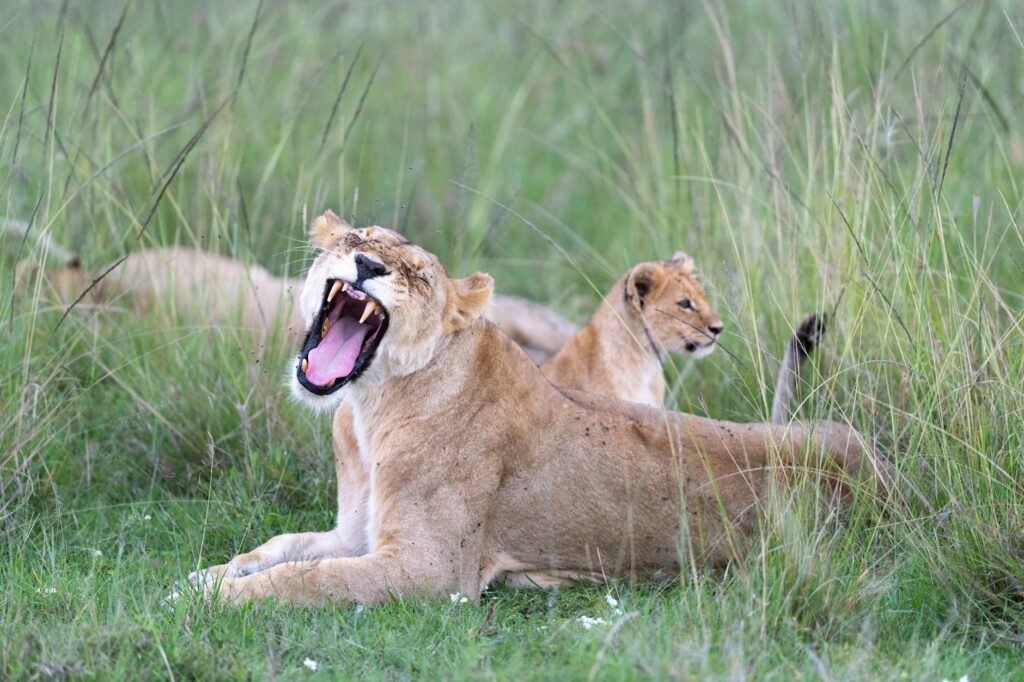
Yes, Nairobi National Park has a resident lion(Panthera pardus) population, and lions are one of the park’s most important large predators. They are not only a realistic safari target species but also one of the clearest ways to understand how Nairobi National Park functions as a small, city-edge savannah ecosystem. The best official planning estimate in the Nairobi National Park Management Plan is about 45 lions, including three prides and at least one coalition of nomadic sub-adults.
Research on collared lions shows that Nairobi’s lions use unusually small home ranges for lions, move in and out of the park’s buffer areas, and are tightly linked to prey movement, livestock predation, and human-wildlife conflict beyond the formal park boundary.
We have a more comprehensive guide on all the big cats, mammals and predators at Nairobi National Park on the Nairobi National Park Animals guide.

What is the scope of this Nairobi National Park lions guide?
This guide is specifically about lions in Nairobi National Park as a wildlife-and-conservation topic. Its purpose is to explain whether lions live in the park, its population, how lions use the landscape, what they prey on, why they move outside the park, how conflict happens, and why lions are one of the strongest species through which to understand Nairobi National Park itself.
This page supports the broader Nairobi National Park wildlife guide by going deep on one flagship predator. It is not the main wildlife overview, not a general big cats in Kenya page, and not a tour booking page. Its dominant intent is narrower: to explain the lion population as a defining ecological attribute of Nairobi National Park.
How many lions are in Nairobi National Park?
Nairobi National Park has a resident lion population, and the most reliable official estimate, from the KWS 2020–2030 management plan, puts it at about 45 lions. Best estimate of its population today in 2026 is between 45 to 50 lions rather than as one exact fixed number. The park supports at least three prides as well as one coalition of nomadic sub-adult males. KWS had earlier reported the population at about 36 lions in early 2016, so the broader trend points to a clear recovery since then. Overall, Nairobi National Park’s lion population appears to have risen from earlier lows and is now generally understood to sit in the mid-40s to around 50, shaped by prey availability, movement from surrounding areas, and ongoing management rather than by a single precisely confirmed census figure.
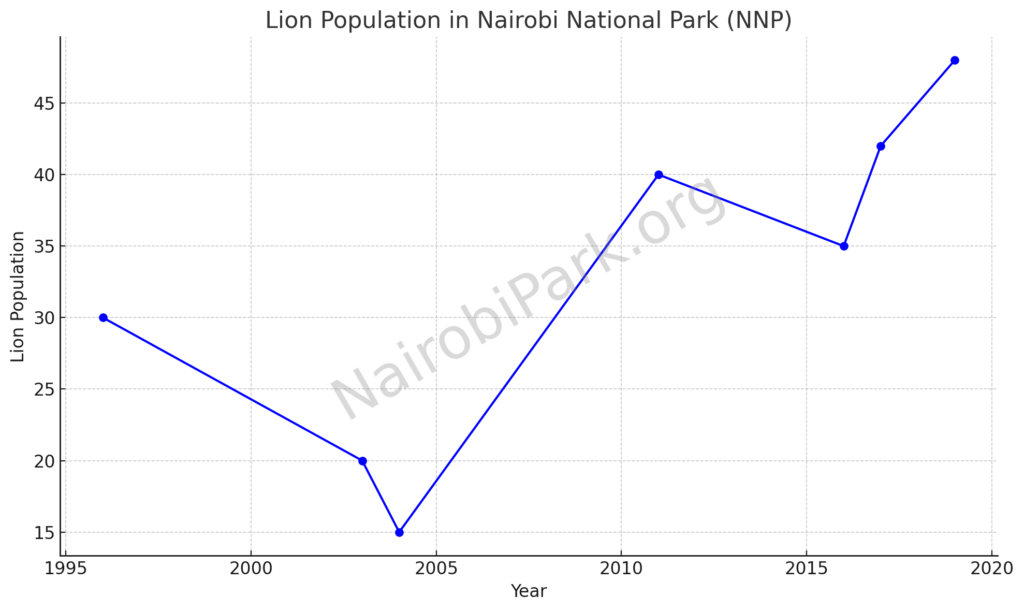
Here is the extrapolated trend for the lion population in Nairobi National Park (NNP) projected up to 2025
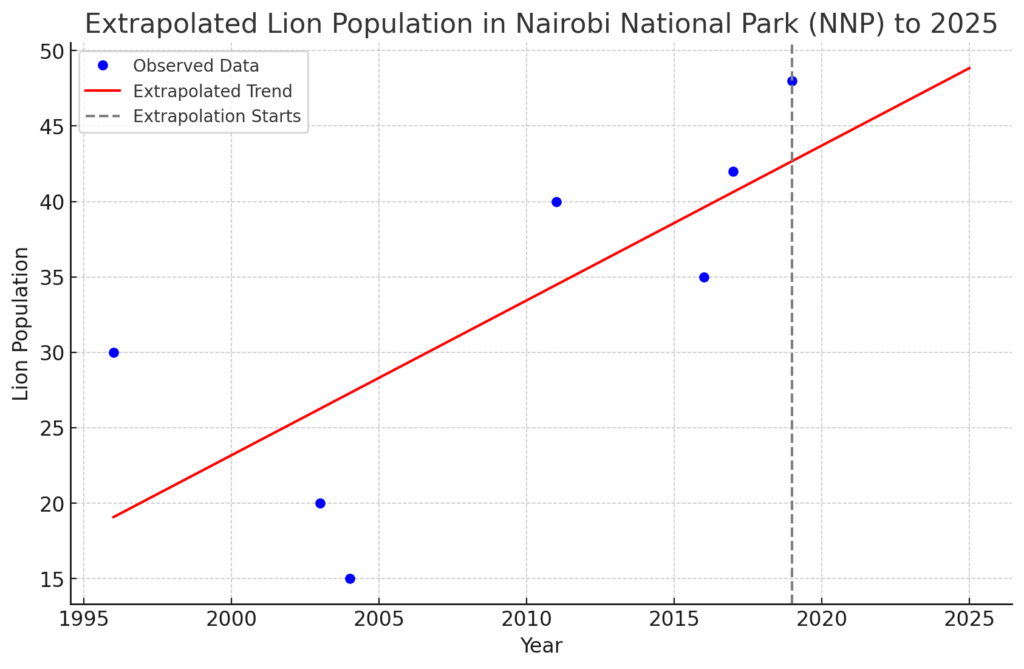
Based on the linear trend, the lion population is estimated to reach around 50 lions by 2025 if current growth patterns continue.
Lion Carrying Capacity at Nairobi National Park (NNP)
In 2021, ecologist Daniel Muteti reported that Nairobi National Park’s (NNP) carrying capacity for lions is around 40, as per The Star Newspaper. This figure represents the maximum number of lions the park can sustainably support based on factors like prey availability, territory size, and ecological balance.
Why 40 Lions?
- Limited Space: NNP spans just 117 km², restricting territory for lions, which are highly territorial animals.
- Prey-Predator Balance: To prevent overhunting of herbivores like zebras and wildebeests.
- Resource Sustainability: Ensuring enough water, cover, and space for hunting.
Current Population Concerns
As of 2019, lion numbers were estimated at 45, and NairobiPark’s projections suggest 45 to 50 lions by 2026, exceeding the park’s capacity. This leads to:
- Ecological Imbalance: Pressure on prey populations and risk of genetic bottlenecks
- Increased Lion Conflicts: Territorial disputes and aggression.
- Rising Human-Wildlife Conflicts: Lions leaving park boundaries, entering Nairobi suburbs.
Is Nairobi National Park’s lion population dense for such a small park?
Yes. The KWS Management plan states that Nairobi National Park has about 38 lions per 100 km², which it describes as higher than the East African average cited there. That matters because the park covers only about 117 km², so lion density is not just a wildlife fact; it is evidence of ecological compression in a tightly bounded system. A relatively high density of large carnivores in a small park increases the importance of prey trends, territorial behavior, dispersal, and human-lion conflict outside the protected area.
Do Nairobi’s lions stay entirely inside the park?
No. Lesilau et al. (2021) recorded 864 roaming events by collared lions into the community lands south of the park between 2014 and 2018. These outings lasted about 18 hours on average, had a median of 9 hours, and in rare cases lasted as long as 12 days.
They are resident, but some also move beyond the park boundary into surrounding areas. The management plan says there are three prides and at least one coalition of nomadic sub-adults in Nairobi National Park, and it adds that some lions have expanded their territories into the park’s buffer zone. The plan also cites collaring evidence that three of four collared lions in one study exited the park at least once every three weeks, while two of those lions spent more than a day outside the park in livestock-ranging areas.
That is one of the most important things to understand about Nairobi National Park lions. They are not purely “inside-park” animals in the way many casual safari readers assume. Their ecology is partly a boundary ecology.
How far do lions in Nairobi National Park usually move?
A 2021 Study on the Spatial Ecology of Lions at Nairobi National Park found that lions in Nairobi National Park traveled an average of about 4.5 km per day. That is relatively short for lions, and the paper interprets this as part of a compressed ranging system in a small, human-pressured landscape.

Which part of the boundary matters most for lion movement?
Lesilau et al. (2021) found that the south-eastern sector was the main exit and entry point between Nairobi National Park and the surrounding community lands, making the southern boundary especially important for both lion ecology and conflict risk. See Nairobi National Park Map
Do lions avoid the city side of the park?
Generally, yes. According to Lesilau et al. (2021), collared lions were on average about 2.34 km from the fence-line and generally avoided the urban fringe, suggesting that disturbance from Nairobi affects how they use the park.
Do lions ever move closer to people?
Yes, but mostly when human activity is lower. Research found that lions moved closer to the fence-line during quieter periods, especially at night, when they were more able to search for resources and move with less disturbance.
What habitats inside the park do lions prefer?
The 2021 study by Lesilau et al. found that lions in Nairobi National Park most strongly preferred riverine woodland, followed by bushland and scattered tree grassland, while forest and some shrubland habitats were used less. Read about Nairobi National Park habitats with map of where rivervine woodlands are
Does season affect lion movements?
Yes, especially outside the park. Lesilau et al. (2021) found that lions roamed farther, more often, and for longer during the wet season, which is one of the clearest signs that conflict risk increases seasonally.
Why does the wet season increase conflict risk?
According to the 2021 Research the wet season pulls both wildlife and livestock more heavily into the southern community lands, and lions may follow those resources outside the park. That is why the risk of livestock depredation rises in the wet season.
Are Nairobi National Park’s lions isolated?
Lesilau et al. (2021) suggest that Nairobi National Park’s lions may be increasingly constrained and partly isolated, with their space use squeezed between the urban edge to the north and community lands to the south.
What is the bigger conservation lesson from the study?
The main lesson from Lesilau et al. (2021) is that conserving lions at Nairobi National Park is not just about protecting lions inside the fence. It is also about protecting space beyond it, especially along the southern dispersal area, and reducing conflict through measures such as buffer zones. Read more about Conservation at Nairobi National Park.
How do Nairobi National Park lions use space?
A 2021 peer-reviewed study on the spatial ecology of Nairobi’s lions found that they showed restricted movements and small home ranges compared with lions in more open and less urbanized systems. The study reported average daily movement of about 4.5 km/day and mean home ranges of about 49 km², with males generally using larger ranges than females. It also found that lions expanded movement particularly at night when human activity was lower.
This matters because it shows that lion behavior in Nairobi National Park is not explained only by pride structure and prey availability. It is also shaped by the park’s edge effects, surrounding human settlement, and the need to navigate a semi-fenced, disturbance-heavy landscape. That makes Nairobi’s lions ecologically distinctive within Kenya’s lion populations.
What do lions in Nairobi National Park eat?
The management plan identifies wildebeest and zebra as the two major prey species for lions in Nairobi National Park. The same plan also states that livestock comprises about 15% of the lions’ diet. This is a crucial point because it means the lion story in Nairobi is not only about predator-prey ecology inside a protected area. It is also about how large carnivores interact with the human-dominated landscape beyond the park.
Once livestock becomes a meaningful part of diet, lion ecology becomes inseparable from local husbandry, land use, compensation debates, predator response systems, and retaliation risk. That is why a Nairobi National Park lions article has to cover both wildlife ecology and conflict ecology.
Why do Nairobi National Park lions leave the park?
They mainly leave because prey and ecological opportunity are not confined to the park boundary. The management plan notes that wildebeest and zebra move outside the park during the wet season, and that lions follow them, which then increases livestock predation and risk to people in surrounding areas. That makes lion movement outside the park a structural ecological issue, not an abnormal accident.
This is also why lions are such an important species for understanding Nairobi National Park’s relationship to the wider Athi-Kapiti landscape. A lion population that depends partly on movement beyond the formal boundary is direct evidence that Nairobi National Park cannot be understood as a self-contained wildlife island.
Are Nairobi National Park lions in conflict with people?
Yes. Human-lion conflict is one of the central realities of this population. A 2023 review of human-wildlife conflict around Nairobi National Park found that livestock predation linked to lions is the major conflict type highlighted around the park and that retaliatory killing of carnivores is one of the most serious associated outcomes. The management plan similarly states that lions are the main predators of livestock around Nairobi National Park and cites attacks occurring throughout the year.
This means a serious lion page cannot be written as if the story ends with “there are lions in the park.” In Nairobi, lions are also part of a living conflict geography shaped by pastoral land use, prey shifts, boundary movement, fencing, settlement, and conservation response.
What has Kenya Wildlife Service done to monitor Nairobi’s lions?
KWS has used satellite collaring to monitor lion movement and respond more quickly when lions move toward areas of risk. In its January 2017 release, KWS said one lion had been fitted with a satellite radio collar to help track movement and location and stated that the monitoring system would help response teams act before lions became a threat to Nairobi residents and livestock owners. KWS also noted support from IFAW in the form of donated collars and camera traps.
The management plan builds on this logic by tying lion conservation to movement monitoring, conflict response, husbandry improvement, lion-proof bomas and lighting, and research into the population’s long-term genetic viability.
Are Nairobi National Park lions a sign of a healthy ecosystem?
They are a sign of predator persistence, but not necessarily of ecological ease. Lions still surviving in Nairobi National Park shows that the park retains a functioning large-carnivore role, sufficient prey to support predators, and management capacity to keep the system from collapsing. But the same sources that document lion persistence also document prey decline, lion movement into buffer areas, livestock in the diet, and ongoing conflict beyond the park.
So the better interpretation is that lions show both strength and strain in Nairobi National Park. They confirm that the park still functions ecologically, but they also expose the limits of a compressed, urban-edge protected area.
Are lions easy to see in Nairobi National Park?
Lions are one of the species visitors most hope to see, and they are a realistic target species on a well-timed game drive, but they should not be treated as guaranteed. Sighting quality depends on timing, guide quality, recent movement, vegetation cover, and whether lions are using core park habitat or ranging toward outer areas. Research showing small home ranges and strong nocturnal adjustment to lower human activity helps explain why sightings can be good but still variable.
That means the most accurate visitor-facing answer is that Nairobi National Park is strong enough for real lion possibilities, especially on good early drives, but lion sightings remain ecological events rather than fixed tourist displays.
Why lions are one of the best ways to understand Nairobi National Park
Lions in Nairobi National Park are big cats living at the ecological edge. They survive in a small protected area beside a capital city, in a landscape where territory, prey movement, buffer land, livestock predation, and conflict management all shape how the population functions. That makes lions one of the clearest species through which to understand the park itself. Nairobi National Park is not just a convenient safari near the city. It is a pressured carnivore landscape still trying to hold ecological function under urban expansion and shrinking space, and the lion population makes that pressure visible.
Factors Influencing Lion Population Growth
- Immigration from Adjacent Areas: Lions have migrated into NNP due to habitat loss and increased human activities outside the park.
- Conservation Initiatives: Improved anti-poaching measures and wildlife management strategies have contributed to population stability.
- Prey Availability: The park supports a healthy prey base, including zebras, wildebeests, and buffaloes.
- Human-Wildlife Conflict Mitigation: Efforts to reduce conflicts with local communities have also helped sustain the population.
Lions Leaving the Park: A Growing Concern
In recent years, there have been cases of lions wandering out of the park and onto the streets of Nairobi. These incidents are often triggered by:
- Weak Park Fencing: Gaps in the park’s perimeter allow lions to roam freely.
- Territorial Disputes: Young males are sometimes pushed out by dominant lions, prompting them to explore beyond the park.
- Attraction to Urban Areas: Noise, lights, and the scent of livestock can draw lions towards human settlements.
Notable Incidents:
- 2016 Incident: A lion named Mohawk famously roamed Nairobi’s streets before being tragically shot due to safety concerns.
- 2019 Sightings: Several lions were spotted in Lang’ata and Mombasa Road areas, causing temporary panic among residents.
Safety Guidelines for Residents and Visitors
- Stay Calm: If you encounter a lion, do not run. Maintain eye contact, make yourself appear larger, and back away slowly.
- Report Sightings Immediately: Contact the Kenya Wildlife Service (KWS) hotline.
- Secure Livestock: Use strong enclosures to prevent attracting lions.
- Avoid Night Travel Near the Park: Lions are more active during dawn and dusk.
Conservation Challenges
- Urban Encroachment: Nairobi’s expansion continues to reduce wildlife corridors.
- Human-Wildlife Conflict: Incidents often lead to retaliation killings.
- Genetic Diversity: The park’s fenced environment can limit gene flow.
Conservation Strategies
- Wildlife Corridors: Establishing safe passages to allow natural movement between ecosystems.
- Community Involvement: Educating local communities on coexisting with wildlife.
- Improved Fencing: Strengthening park boundaries while maintaining ecological integrity.
- Research and Monitoring: Continuous tracking of lion movements and behavior to inform management decisions.
FAQ: Nairobi National Park lions
Does Nairobi National Park have lions?
Yes. Nairobi National Park has a resident lion population documented by KWS and lion research, including multiple prides and nomadic sub-adult males.
How many lions are in Nairobi National Park?
Publicly cited figures vary by year and source. KWS reported about 36 lions in early 2016, later described the park as having more than 30 lions, and the 2020–2030 management plan estimated about 45 lions.
Do lions leave Nairobi National Park?
Yes. Collaring evidence cited in the management plan shows that some lions regularly move into buffer and livestock-ranging areas outside the formal park.
What do Nairobi National Park lions prey on?
The main prey species identified in the management plan are wildebeest and zebra, but livestock also makes up part of lion diet around the park.
Why are Nairobi National Park lions important?
They are important both as apex predators and as indicators of how the park functions ecologically under urban-edge pressure, prey decline, and human-wildlife conflict.