Where the Masai giraffe stood before 2025
For more than 250 years — since Carl Linnaeus placed all giraffes under a single species name, Giraffa camelopardalis, in 1758 — the animal you see browsing acacia trees at Nairobi National Park was classified as a subspecies. Its full scientific name was Giraffa camelopardalis tippelskirchi: one taxon among nine accepted subspecies of a single, continent-wide species. Under this framework, the Masai giraffe had no independent standing as a species. It was a regional variant — distinct in coat pattern and distribution, but taxonomically subordinate to a single giraffe species that was treated as genetically unified across Africa.
That is no longer the case.
August 2025: A landmark reclassification
In August 2025, the IUCN Species Survival Commission’s Giraffe and Okapi Specialist Group (GOSG) Taxonomic Task Force formally recognised four distinct giraffe species, overturning the previous classification of all giraffes as a single species. The taxonomic review marks a major milestone in giraffe taxonomy and reshapes how giraffe diversity is understood and conserved.
The four recognised species are:
| Species | Scientific name | Subspecies | Approx. population |
|---|---|---|---|
| Masai giraffe | Giraffa tippelskirchi | Masai s.s. (G. t. tippelskirchi); Luangwa/Thornicroft’s (G. t. thornicrofti) | ~43,900 |
| Northern giraffe | Giraffa camelopardalis | West African, Kordofan, Nubian | ~7,037 |
| Reticulated giraffe | Giraffa reticulata | None proposed | ~20,091 |
| Southern giraffe | Giraffa giraffa | South African; Angolan | ~68,836 |
The Masai giraffe — Giraffa tippelskirchi — has therefore been elevated from a subspecies to a full species in its own right. The research also established that Thornicroft’s giraffe, found in the Luangwa Valley of Zambia, is a subspecies of the Masai giraffe rather than a separate entity.

The Masai giraffe was originally described and given its binomial name by German zoologist Paul Matschie in 1898, after a specimen was brought back from what is now northern Tanzania. It was named in honour of Herr von Tippelskirch, a member of that German scientific expedition. For over a century the name tippelskirchi persisted — but always as a subspecies tag appended to camelopardalis. The 2025 decision restores tippelskirchi as a full species name in its own right.
How the science got there: a decade of genetic evidence
The reclassification did not happen overnight. The discovery first emerged in 2016, when the Giraffe Conservation Foundation and Germany’s Senckenberg Biodiversity and Climate Research Centre published genetic data showing deep divergences between giraffe populations — comparable to the differences between polar bears and brown bears. Despite their similar appearance, the study revealed that giraffes are not one species but four: the Masai giraffe, northern giraffe, reticulated giraffe, and southern giraffe.
The 2016 findings were controversial. Coat patterns and body shape alone had never seemed sufficient to justify species-level splits — and superficially, giraffes across Africa look broadly similar to the non-specialist eye. But explicit gene flow analyses identified less than one migrant per generation between the four lineages, including between the closely related northern and reticulated giraffe. Gene flow analyses and population genetics from the extended dataset confirm four genetically distinct giraffe clades and support four independent giraffe species.
The detailed taxonomic review was conducted by the IUCN Species Survival Commission’s Giraffe and Okapi Specialist Group Taxonomic Task Force, which evaluated extensive genetic data from multiple peer-reviewed studies. Many of these studies focused on giraffe genetics, making the giraffe one of the most genetically well-studied large mammals in Africa.
These lineages are estimated to have diverged roughly 230,000 to 370,000 years ago — during the Middle Pleistocene, a period of significant climatic and landscape upheaval across Africa. The divergence timescales are comparable to well-known splits between other mammal species pairs, giving the four-species model strong temporal as well as genetic grounding.
A 2024 study published in PLOS ONE added skull morphology to the evidence base, showing that the four giraffe lineages have distinct cranial shapes — physical differences in the skeleton that reinforce the genetic signal and give the reclassification multi-line support beyond DNA alone. nih
What the Masai giraffe’s full species status actually means
The shift from subspecies to species is not a semantic change. It has direct, material consequences for how Giraffa tippelskirchi — including the population at Nairobi National Park — is managed, funded, assessed, and protected.
1. Its own IUCN Red List assessment
As a subspecies, the Masai giraffe’s conservation status was bundled into a single assessment of all giraffes together — and that combined assessment rated giraffe as Vulnerable. As a full species, Giraffa tippelskirchi now receives its own independent IUCN Red List evaluation, based on its own population data, decline trajectory, and threat profile. Preliminary findings suggest that three of the four species — the Masai, Northern, and Reticulated — are threatened, reflecting declines and fragmentation that were easy to underestimate when numbers were pooled.
For the Masai giraffe specifically, the GCF’s State of Giraffe 2025 report notes there is now a strong case for listing three of the four species as Endangered or Vulnerable. Masai giraffe numbers have remained stable across Kenya over the past five years, which is described as a sign of resilience — but the species declined by nearly 40% over the previous three decades. A species-level Red List assessment working across a 30-year timeframe will capture that historic decline in a way that subspecies-level pooling never could.
2. Targeted conservation strategy, not one-size-fits-all management
The new classification could lead to a change in global conservation policies, with each species now independently assessed for the IUCN Red List, opening the door to targeted protections. The GCF says the next step is to implement species-specific strategies — habitat protection, anti-poaching patrols, and community conservation — instead of treating giraffes as a uniform population.
This matters enormously in practice. The challenges facing Masai giraffes in the fragmented urban-edge landscape of Nairobi National Park are fundamentally different from the challenges facing northern giraffes in the politically unstable Sahel. Treating them as variants of the same species meant conservation funding and policy responses were blunt instruments. Species-level recognition allows — and scientifically demands — strategies specific to Giraffa tippelskirchi: its habitat requirements, its dispersal ecology, its genetic substructure, and its threat profile in Kenya and Tanzania specifically.
3. Potential new legal protections under international law
The US Fish and Wildlife Service proposed listing reticulated and Masai giraffes as threatened species under the Endangered Species Act, with tailored protections through the ESA’s section 4(d). Even though giraffes are not native to the US, the Endangered Species Act is designed to help protect endangered and threatened species domestically and abroad. A threatened or endangered listing under the ESA restricts the import and trade of the species and its parts into the United States — a significant lever given the US market for trophy hunting, wildlife products, and live animal trade.
Under CITES, giraffes are already listed on Appendix II — meaning commercial international trade requires documentation that it is legal and sustainable. The four-species model creates the possibility of uplisting individual species more easily, since each can now be assessed on its own population data rather than averaged across the whole genus.
4. Conservation funding can follow species-level urgency
International conservation funding mechanisms — from bilateral government programmes to foundation grants to NGO campaigns — increasingly direct resources to species-level targets. A population of 43,900 Masai giraffes that is its own species, assessed as threatened, makes a stronger and more specific case for dedicated funding than the same animals described as one of nine subspecies contributing to a total of 117,000 giraffes continent-wide. The reclassification changes the arithmetic of conservation fundraising in a way that is likely to benefit Kenyan giraffe conservation directly.
What this means specifically for the Masai giraffes at Nairobi National Park
The approximately 100–120 Masai giraffes inside Nairobi National Park are now members of a formally recognised, threatened, full species — not a regional variant of a broadly distributed animal. That changes their conservation standing in several concrete ways.
The in-park population has greater individual conservation value. When the Masai giraffe was a subspecies of a species distributed across Africa in roughly 117,000 animals, the loss of a few dozen individuals from any one location was relatively easy to absorb statistically. As one of roughly 43,900 surviving members of a distinct, threatened species whose range is confined to Kenya and Tanzania, each individual at Nairobi National Park carries more conservation weight.
Kenya’s giraffe management plans now operate within a different framework. KWS’s management plan for Nairobi National Park already includes Masai giraffe monitoring, habitat assessment, and research partnerships. The species-level reclassification strengthens the scientific basis for those activities and creates a clearer mandate for species-specific action — including monitoring of genetic health in a population that is becoming increasingly isolated from wider G. tippelskirchi populations to the south.
The corridor question becomes more urgent, not less. The dispersal land south of Nairobi National Park — the Kitengela plains and the Athi-Kapiti rangelands — represents the connection between the in-park Masai giraffe population and the broader Kenyan population. As a subspecies, the isolation of the NNP population was a local wildlife management concern. As a species, isolation of NNP’s Giraffa tippelskirchi from the wider metapopulation becomes a species-level genetic concern. The 31.6% decline in giraffe numbers recorded in Athi-Kapiti counts between 2021 and 2024 is now a decline within a threatened species, not a fluctuation in a subspecies of a Vulnerable animal.
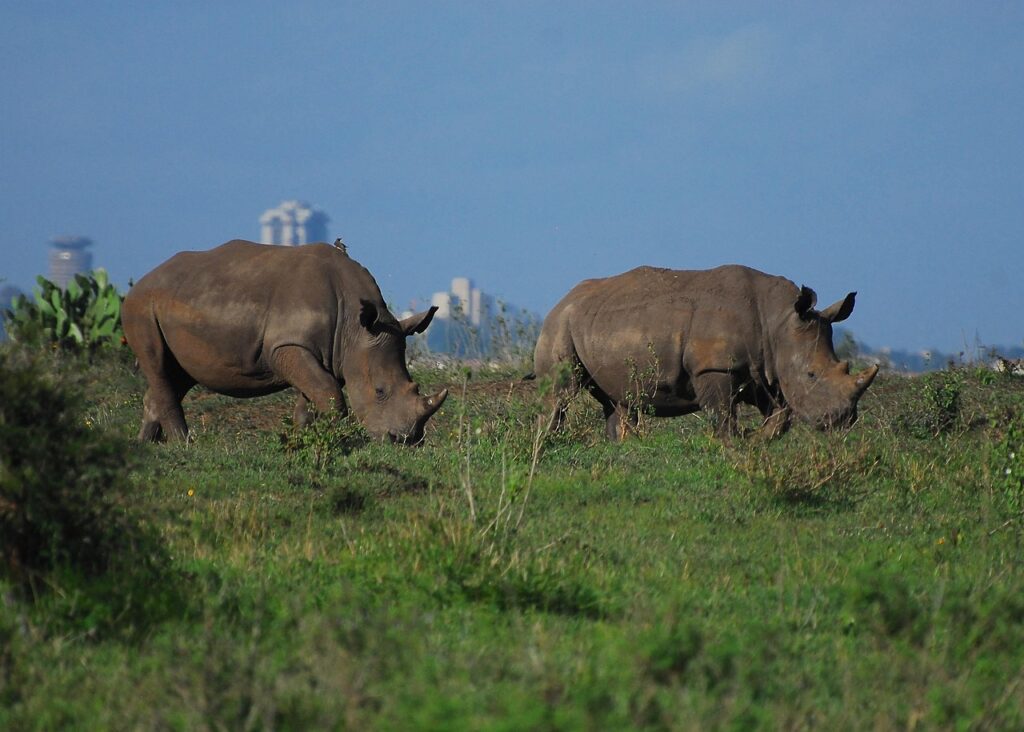
The iconic skyline photograph acquires a different caption. A Masai giraffe photographed against the Nairobi skyline was already a powerful conservation image. Now that the animal in the frame is a member of a formally distinct, genetically unique, threatened species — one found nowhere in the wild outside Kenya and Tanzania — the image carries additional scientific weight. What visitors see when a tower of giraffes browses acacia at sunrise above the city is not a regional variant of a widespread African animal. It is a member of a species that has lived on this continent for hundreds of thousands of years and now survives in an estimated 43,900 individuals, navigating one of the most pressured urban-edge conservation landscapes on Earth.
A note on the ongoing science
The GOSG emphasises that taxonomy is an evolving science. As new evidence emerges, the group will continue to reassess classifications to ensure conservation strategies remain grounded in the most up-to-date understanding of giraffe diversity. The four-species model is now the IUCN-endorsed consensus, but specific questions — including the precise status of Thornicroft’s giraffe as a Masai giraffe subspecies, and how cranial morphology data should weight alongside genetic evidence — will continue to be refined as more data accumulate.
What is not likely to change is the fundamental conclusion: the Masai giraffe is genetically, morphologically, and evolutionarily distinct from the other three giraffe species. The classification question that took decades to resolve is settled. What happens next in terms of Red List status, international legal protection, and Kenya-specific conservation investment depends on how policy and funding respond to a science that has now spoken clearly.
The giraffe at Nairobi National Park has always been worth understanding. It is now, officially, a species you cannot find anywhere else in the world outside of Kenya and Tanzania. That is a fact that changes what it means to see one.
Quick Facts: Masai Giraffe at a Glance
| Feature | Detail |
|---|---|
| Scientific name | Giraffa tippelskirchi |
| Also called | Kilimanjaro giraffe, Maasai giraffe |
| IUCN conservation status | Endangered |
| Height | Males up to 5.5 m (18 ft); females up to 4.8 m (16 ft) |
| Weight | Males 1,100–1,900 kg; females 700–1,200 kg |
| Estimated NNP population | Approximately 100–120 individuals |
| Athi-Kapiti ecosystem trend | Declined 31.6% between 2021 and 2024 |
| Coat pattern | Irregular, jagged, star-shaped patches — unique to each individual |
| Diet | Obligate browser; primarily acacia and other woody plants |
| Daily feeding time | 16–20 hours |
| Gestation period | 13–15 months |
| Lifespan | 25–30 years in the wild |